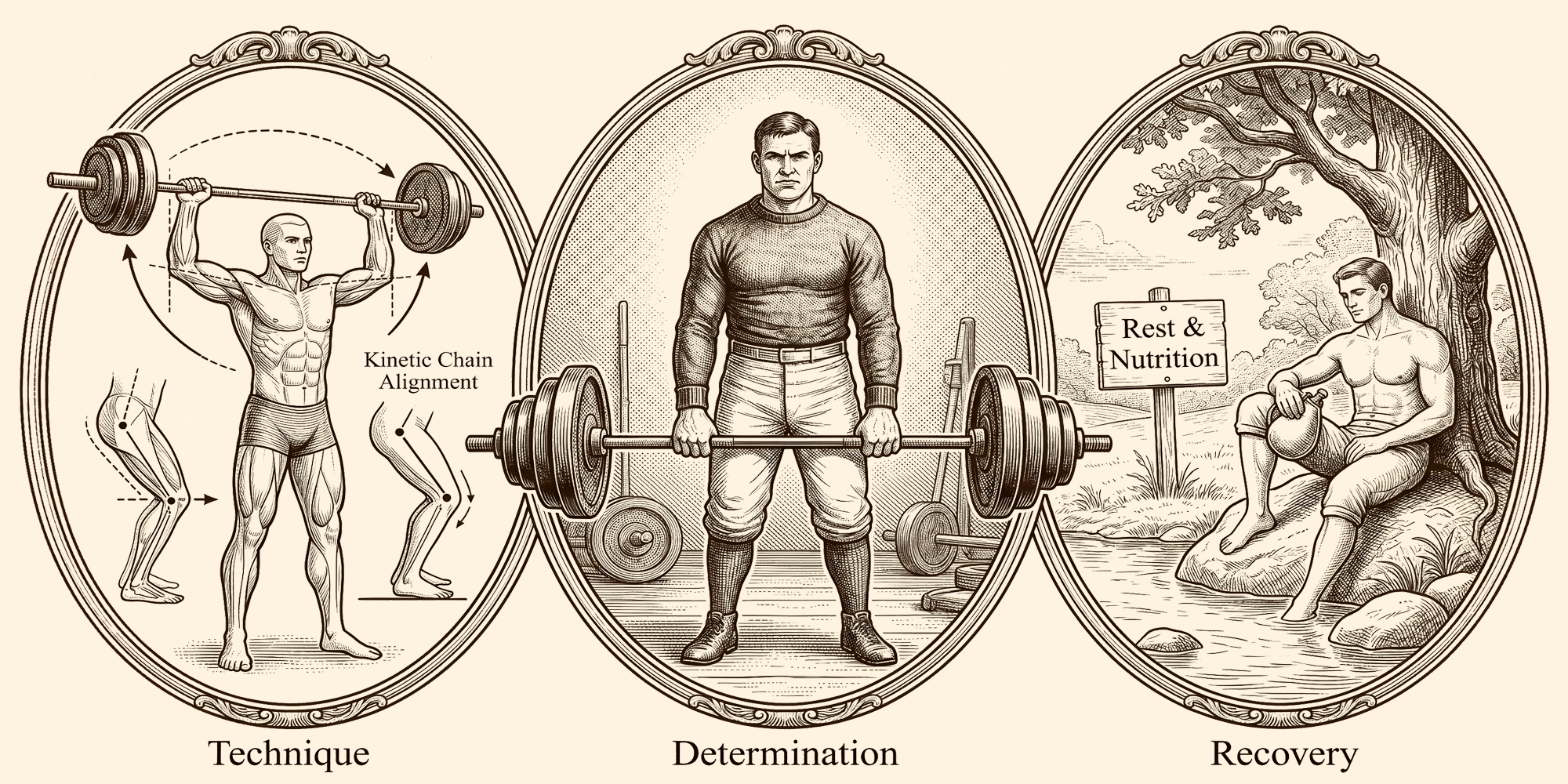
For decades, sports culture has treated the pre-workout warm-up as an unassailable commandment. Physical culture enthusiasts and athletes are routinely told that jumping on a stationary bike, breaking a sweat, and stretching their muscles is an essential shield against injury and the only way to unlock physical potential.
However, when applied to slow-speed, high-intensity physical activity—specifically lifting weights between 75% and 100% of your one-repetition maximum (1RM)—this deeply ingrained dogma collapses under scientific scrutiny. Modern biomechanics, neurophysiology, and sports epidemiology reveal that the traditional warm-up ritual is not only pointless for heavy lifting, but actively harmful to performance and structural safety.
1. The Psychological Trap: Cultivating Artificial Fragility
The traditional warm-up operates largely as a behavioral crutch that breeds acute psychological insecurity. Neuroscientific data shows that rigid pre-performance rituals act merely as anxiety buffers, dampening the brain’s neural response to failure—specifically the Error-Related Negativity (ERN) signal in the cortex (Hobson et al., 2017).
While this ritualistic sequence makes an athlete feel safe, it introduces a profound behavioral vulnerability: dependency. By marrying their perceived capability to a specific, rigid physical sequence, athletes cultivate an internal belief that their bodies are inherently fragile and structurally compromised without it. If their warm-up routine is shortened, disrupted, or omitted due to real-world logistics, the athlete experiences acute mental insecurity. This psychological hesitation directly sabotages their aggressive intent and neural drive before they ever touch the barbell.
The “Thought Virus” of Structural Fragility
The mental trap of the over-engineered warm-up is driven by what modern pain science calls the Postural-Structural-Biomechanical (PSB) model. This outdated framework treats the human body like a fragile, mechanical clock—convincing lifters that if their pelvis is slightly misaligned, or if a specific stabilizer isn’t explicitly “activated” via a dynamic drill, their structural integrity will collapse under load. Clinical evidence shows that this hyper-vigilance implants a literal “thought virus” in the athlete’s mind, breeding a state of chronic catastrophization.
When you force yourself through a complex corrective circuit just to safely approach an empty barbell, you are sending a massive threat signal to your own brain. You are actively reinforcing the narrative that your body is inherently vulnerable, unstable, and unbraced. In response to this elevated threat perception, the central nervous system acts reflexively to protect you: it protectively down-regulates voluntary motor drive and restricts alpha motor neuron recruitment. By obsessively preparing the body to prevent an imaginary injury, you trigger the exact neurological defense mechanisms that cripple your maximum absolute strength.
2. The Neurological and Metabolic Tax: Central Fatigue and ATP Depletion
Lifting at 75–100% 1RM relies exclusively on the highly volatile phosphagen (ATP-PCr) energy system to fuel short, maximal bursts of work. Muscular stores of Adenosine Triphosphate (ATP) and Phosphocreatine (PCr) are exceptionally small, sustaining peak power for a mere 6 to 10 seconds before hitting a bioenergetic wall.
Protracted warm-ups and the practice of “climbing the weight ladder” compromise this engine through two primary pathways:
- The Phosphagen Drain: Every non-essential repetition drains finite ATP reserves into Adenosine Diphosphate (ADP) and inorganic phosphate (Pi). Because full PCr resynthesis requires 3 to 5 minutes of complete rest, stacked warm-up sets create a chronic energy deficit before the true work begins. Furthermore, the rapid accumulation of Pi and hydrogen ions (H+) within the muscle cells physically disrupts calcium dynamics, directly weakening the binding rigidity of actin-myosin crossbridges and dropping your torque capacity.
- The Neural Drain (Central Fatigue): Wasting volume on the weight ascent induces deep central fatigue (Thibaudeau, 2022). This operates silently within the central nervous system, directly weakening the central excitatory drive—the electrical signal sent from the brain to the working muscles.
By the time the lifter finally reaches the peak of the weight pyramid, they stand at the apex partially exposed. Their cellular ATP reservoirs are depleted, their neural battery is dulled, and high-threshold motor unit recruitment is severely blunted at the exact moment they need it most.
3. The Physiological Fact: Absolute Strength is Temperature-Immune
The primary justification for a traditional warm-up is the “thermal factor”—the idea that increasing local tissue temperature optimizes muscle function. While a 1°C increase in muscle temperature does improve rate-dependent properties (such as explosive contraction velocity and speed), a rigorous meta-analysis confirmed that absolute strength is entirely immune to temperature shifts within normal physiological ranges (Wilson et al., 2025).
Maximal force production is fundamentally a “numbers game” at the cellular level. It is dictated by the total number of actin-myosin crossbridges attached in parallel at any single given moment. Once your muscle tissue is out of a state of severe environmental hypothermia, the maximum number of crossbridges your nervous system can recruit hits a structural plateau.
Heating the muscle further does not allow actin and myosin filaments to pack tighter or generate more raw isometric tension (Wilson et al., 2025). Because heavy lifting relies on absolute force production at low, involuntary velocities, forcing a lifter to undergo a sweating ritual offers zero physiological advantage to their top-end strength.
4. Neuromuscular Deactivation: The Deficit of Pre-Lift Stretching
Warming up frequently involves static or prolonged stretching, a practice that is profoundly counterproductive before heavy lifting. Holding elongated muscle positions induces an acute strength deficit that paralyzes peak performance.
When you subject a muscle to pre-lift stretching rituals, you trigger a cascade that compromises both structure and signal through the exact biomechanics of structural slack:
Afferent Signal Blunting (Neural Drive Suppression): Static stretching desensitizes internal muscle spindles and reduces the amplitude of the brain’s natural stretch reflex. Muscle spindles rely on baseline tissue stiffness to detect changes in length and velocity. By artificially softening the MTU, you numb these spindles, blunting the central nervous system’s ability to rapidly recruit high-threshold motor units when under the barbell. The central nervous system loses its primary peripheral gauge for tension, forcing a protective down-regulation of voluntary motor drive (Chaabene et al., 2019).
Increased MTU Compliance (Mechanical Slack): Stretching alters the viscoelastic properties of the muscle-tendon unit, making it overly compliant. In absolute strength (75–100% 1RM), compliance is a structural liability. A compliant muscle-tendon unit (MTU) replaces a stiff, highly responsive structural system with a loose, stretched-out system. This delays the transmission of tension from the contracting sarcomeres to the skeleton, severely tanking your initial Rate of Force Development (RFD) and degrading peak torque output. You cannot drive maximum torque through a structurally slackened muscle.
5. The Data Gap: The Statistical Failure of Stretching in Injury Prevention
The most pervasive defense of the pre-lift stretching ritual is that it acts as a prophylactic shield against acute muscle tears, pulls, and strains. However, when global epidemiological data is pooled, this claim completely evaporates. The belief that stretching prevents injury is an inherited cultural myth, flatly contradicted by decades of clinical tracking.
In a landmark systematic review and meta-analysis published in the British Journal of Sports Medicine, researchers analyzed 25 randomized controlled trials tracking a massive sample size of 26,610 participants with 3,464 documented injuries (Lauersen et al., 2014). The researchers isolated the true preventive capabilities of stretching against strength training and proprioception protocols. The results proved no beneficial effect for stretching on injury prevention whatsoever, meaning injury risk was statistically identical whether athletes stretched or not. Conversely, strength training programs cut sports injury rates down to less than one-third.
This absolute lack of efficacy is consistently mirrored across large-scale literature reviews. A comprehensive meta-analysis by Thacker et al. (2004) scrutinized over 360 articles and confirmed that stretching was not significantly associated with a reduction in total injuries. Furthermore, when isolated specifically to the pre-workout window, a systematic review investigating static stretching as part of a warm-up protocol found moderate to strong evidence that routine pre-exercise stretching fails to reduce overall injury rates (Small et al., 2008).
6. The Circular Fallacy: Why Pre-Lift Joint Rotations Are Redundant
A common subset of the warm-up ritual involves stand-alone joint rotations—such as rolling the ankles, twisting the knees, or circling the hips. For an athlete who already possesses baseline structural mobility, executing these empty, unloaded movements before a heavy lift is completely flawed:
- The Anatomy Mismatch: Consider the common “knee circle.” Biomechanically, the knee is a modified hinge joint designed to operate almost exclusively in a single plane (flexion and extension)—it is not a ball-and-socket joint. Forcing the knee into passive, unloaded circular rotation introduces micro-shear vectors outside of its planar tracking axis and strains the ligamentous attachments (MCL/LCL) that are supposed to act as rigid stabilizers during a heavy, linear lift (Guo et al., 2020).
- The Synovial Fluid Fallacy: Proponents argue that rotations are necessary to “pump synovial fluid” and lubricate the joint. However, human cartilage lubrication operates via interstitial fluid pressurization. This protective fluid barrier is a dynamic sponge-like mechanism that is only generated by actual loading and axial compression (Ateshian, 2009). Spinning a joint under zero load generates zero hydrostatic pressure, failing entirely to prime the articular cartilage for a heavy load.
- Reinforcing the Fragility Narrative: Just like general warm-ups, these repetitive joint circles feed the psychological trap. They send a subconscious signal to the brain that the joints are dry, fragile, and unready to perform until a complex series of circular movements is completed (Hobson et al., 2017).
7. The True Etiology of Injury: Pathomechanics over Temperature
The conventional belief that warm-ups prevent injury is flatly contradicted by modern sports epidemiology. Non-contact soft tissue injuries, acute tears, and cramps are heavily driven by structural imbalances, poor recovery, and incorrect joint alignment under load, not by “cold” tissue.
When preparing to lift heavy weights, safety is a direct byproduct of precise kinetic tracking and motor control. Injuries emerge from clear structural and systemic faults:
Muscle Imbalances from Improper Training
- Single-Joint Movements: Over-reliance on isolated, single-joint movements fragments the kinetic chain, leaving critical stabilizing muscles under-developed.
- Kinetic Chain Dominance: Overusing one kinetic chain compared to its opposing counterpart (e.g., severe quad dominance over under-active hamstrings) alters normal joint kinematics. This creates dangerous shear forces during complex, multi-joint sporting actions or heavy compound lifts.
Pathomechanical Deviations Under Load
A generic warm-up does absolutely nothing to correct structural pathomechanics. For example, during a heavy squat, a common failure point is dynamic knee valgus—the inward collapse of the knees paired with internal rotation of the thighs. This structural breakdown places massive asymmetric tensile stress on the ligaments and causes severe rotational torsion between the tibia and femur.
If an athlete undergoes an exhausting, high-volume warm-up routine, they actively fatigue primary joint stabilizers (like the gluteus medius). Consequently, their capacity to resist internal femoral rotation decreases when they get under a heavy barbell. Furthermore, the elevated endorphins from a warm-up can temporarily mask localized joint restrictions, causing the athlete to push through a pathological path of least resistance.
Systemic Overtraining and Poor Recovery
Muscular cramps and acute tissue tears are primarily indicators of systemic fatigue and exhausted recovery mechanisms. When training volume chronically outpaces structural repair, neuromuscular control is severely compromised. No amount of metabolic warming or rhythmic movement can rewrite the reality of a structurally frayed muscle unit or a fatigued nervous system.
The Analgesic Mask: Neurological Modulation vs. Structural Repair
A final, critical danger of traditional preparation routines is the use of static stretching and self-myofascial release (SMR)—such as aggressive foam rolling or lacrosse ball smashing—to numb localized discomfort before lifting. The fitness industry loves to claim that pre-lift rolling physically alters tissue architecture by “breaking up scar tissue” or “realigning fascia.” Modern clinical neurobiology completely refutes this mechanical myth; it is physically impossible to deform dense human fascia using the blunt, brief pressure of a foam roller.
What you are actually experiencing is an acute, transient antalgic and analgesic effect driven by temporary neurological modulation. By pressing your body weight into a dense roller, you flood the fast-acting mechanical receptors ($A\beta$ fibers) in your skin and muscles with an intense sensory overload. According to the Gate Control Theory of Pain, these rapid mechanical signals reach the dorsal horn of the spinal cord first, effectively “closing the gate” and drowning out the slower, incoming warning signals (nociception) traveling along unmyelinated C-fibers from a strained or tight tissue.
Static stretching achieves a similar anesthetic result by altering sensory perception and increasing “stretch tolerance” via nociceptive desensitization (Støve et al., 2024). You haven’t repaired a single collagen fiber or restored exhausted tissue; you have merely used a sensory trick to turn down the brain’s internal threat volume and silence the body’s primary protective alarm system.
Applying this analgesic mask right before a maximal attempt is highly dangerous. Forcing the nervous system to recruit high-threshold motor units under heavy axial loads (75–100% 1RM) while blinding the central nervous system to the true status of the peripheral tissue overrides your body’s built-in protective feedback loops. This pushes a structurally vulnerable or exhausted muscle into a high-torque environment where it can no longer safely manage the load, clearing a direct path for catastrophic structural tissue failure and severe overtraining.
8. The Temporal Paradox: Why Injuries Cluster in the Fully “Warmed” State
The ultimate defense of the traditional warm-up protocol rests on a deeply flawed epidemiological premise: that muscle tissue and joint structures fail primarily because they are “cold.” If this cultural dogma were true, acute soft-tissue tears, joint subluxations, and structural failures would spike drastically during the first fifteen minutes of a training session or competitive match when tissue temperature is at its baseline.
However, when large-scale sports epidemiology tracks the precise timeline of structural trauma, the data exposes a profound paradox. Injuries do not happen when athletes are “cold.” Instead, injuries show a massive temporal cluster in the latter two-thirds of a session, accelerating precisely when the body is at its peak thermal temperature and completely “warmed up.”
The temporal injury risk corridor breaks down as follows across a standard high-intensity session:
- 0 to 20 Minutes (The “Cold” Fallacy Window): This initial phase immediately following a minimal or omitted warm-up demonstrates the lowest structural risk and the lowest recorded injury incidence.
- 20 to 40 Minutes (Mid-Session Metabolic Accumulation): Structural risk elevates to moderate as localized energy substrates begin to deplete and repetitive forces accumulate.
- 40 to 60+ Minutes (The Exhaustion Zone): This final phase presents a severe structural risk, housing a massive statistical cluster of catastrophic soft-tissue tears and joint failures.
This absolute failure of the warm-up’s protective shield is consistently demonstrated across diverse athletic populations:
- The Second-Half Spike: In high-velocity, high-intensity collision sports, injury distribution is heavily skewed toward the final stages of a session. Longitudinal tracking published in the British Journal of Sports Medicine revealed that 60% of all match injuries occur exclusively during the second half of play (Fuller et al., 2016). This statistical skew is reinforced by club-level audits, which show that between 71% and 73% of all structural failures manifest deep within the final third of exposure (Johnston et al., 2018).
- The Final-15 Fatigue Window: Prospective tracking over consecutive competitive seasons reveals that the lowest injury incidence occurs during the initial 15 minutes of a session—the exact window where an athlete is technically at their “least warmed up” state. Conversely, acute muscle tears, ligamentous strains, and structural failures explicitly cluster in the final 15 minutes of each training or playing half (Mallo et al., 2018).
The Mechanism: Neuro-Mechanical Failure Under Load
The reason structural trauma waits until the first third of a session has passed is that injury is fundamentally a problem of neuro-mechanical failure, not tissue temperature. Elevating local tissue temperature via a protracted warm-up does absolutely nothing to shield an athlete from the two primary drivers of structural trauma:
- The Degradation of Motor Coding (Incorrect Movements): As volume accumulates past the initial third of a session, the motor cortex experiences an acute reduction in central excitatory drive (Thibaudeau, 2022). This neural exhaustion degrades the precision of the brain’s established motor maps. The firing frequency (rate coding) and synchronization of high-threshold motor units begin to waver. Under load, this manifests as immediate pathomechanical deviations—such as an involuntary inward knee collapse (dynamic valgus) or spinal flexion. The kinetic chain does not fail because it is “cold”; it fails because central fatigue forces it to navigate an incorrect, mechanically compromised tracking axis.
- The Loss of Viscoelastic Stiffness: While a high tissue temperature increases muscle compliance (making a muscle loose), heavy resistance and athletic output require structural stiffness to protect joint capsules. Prolonged exertion causes localized micro-damage and eccentric deceleration exhaustion, sapping the muscles’ capacity to act as active stabilizers. When active muscular stabilizers are exhausted, a pathomechanical movement pattern immediately shifts the immense forces of a lift directly onto passive structures—such as tendons, meniscus tissue, and deep spinal ligaments—causing an instantaneous, catastrophic non-contact tear.
By dismantling the myth of the “cold muscle injury,” modern sports science confirms that the ultimate way to safeguard structural integrity is not to extend the warm-up, but to eliminate non-essential volume, protect the central excitatory drive, and strictly enforce the technical boundary of every single repetition.
Conclusion: The Shattering of the Crutch
When preparing to move loads between 75% and 100% 1RM, safety and performance are products of maximum neuromuscular recruitment, structural symmetry, and pristine motor control—none of which are granted by a generic, exhausting warm-up or empty joint rotations. By treating the body as a robust, self-regulating system rather than a fragile machine that requires artificial heating, the lifter preserves their metabolic fuel, maintains absolute muscle stiffness, and protects their joints from fatigue-induced pathomechanical collapse.
References
- Ateshian, G. A. (2009). The role of interstitial fluid pressurization in articular cartilage lubrication. Journal of Biomechanics, 42(9), 1163-1176.
- Behm, D. G., & Chaouachi, A. (2011). A review of the acute effects of static and dynamic stretching on performance. European Journal of Applied Physiology, 111(11), 2633–2651.
- Chaabene, H., Behm, D. G., Negra, Y., & Granacher, U. (2019). Acute Effects of Static Stretching on Muscle Strength and Power: An Attempt to Clarify Previous Caveats. Frontiers in Physiology, 10, 1468.
- Contreras, B. (2013, September 11). Pain Science: An Interview With Pain Expert Jason Silvernail. Bret Contreras Strength Coach.
- Fuller, C. W., et al. (2016). Should player fatigue be the focus of injury prevention strategies for international rugby sevens tournaments? British Journal of Sports Medicine, 50(11), 682-687.
- Guo, M., et al. (2020). Knee Joint Biomechanics in Physiological Conditions and How Pathologies Can Affect It: A Systematic Review. Frontiers in Bioengineering and Biotechnology, 8, 324.
- Johnston, R. D., et al. (2018). The influence of fatigue on rugby league players: Comparing college and club competitions. Scope: Health & Wellbeing, 3, 34-41.
- Hobson, N. M., Bonk, D., & Inzlicht, M. (2017). Rituals decrease the neural response to performance failure. PeerJ, 5, e3363.
- Lauersen, J. B., Bertelsen, D. M., & Andersen, L. B. (2014). The effectiveness of exercise interventions to prevent sports injuries: a systematic review and meta-analysis of randomised controlled trials. British Journal of Sports Medicine, 48(11), 871-877.
- Mallo, J., et al. (2018). Injury incidence according to period of match play and positional demands in professional soccer players. Journal of Sports Science and Medicine, 17(4), 532-541.
- Small, K., McNaughton, L., & Matthews, M. (2008). A systematic review into the efficacy of static stretching as part of a warm-up for the prevention of exercise-related injury. Research in Sports Medicine, 16(3), 213-231.
- Støve, M. P., et al. (2024). The acute effects of static stretching on mechanical pain sensitivity: An exploration of stretch-induced hypoalgesia. European Journal of Applied Physiology, 124(4), 1105-1118.
- Thacker, S. B., et al. (2004). The impact of stretching on sports injury risk: a systematic review of the literature. Medicine & Science in Sports & Exercise, 36(3), 371-378.
- Thibaudeau, C. (2022). Your Warm-Up Is Killing Your Workout… and Gains. T-Nation.
- Wilson, C. J., Nunes, J. P., & Blazevich, A. J. (2025). The effect of muscle warm-up on voluntary and evoked force-time parameters: A systematic review and meta-analysis with meta-regression. Journal of Sport and Health Science, 101024.