Have you ever watched an elite powerlifter pull a world-record deadlift? The barbell bends, the lifter’s face turns purple, and the weight creeps off the platform at a grueling, agonizingly slow pace. It is a spectacular display of human grit and absolute force.
But from a pure physics perspective, there is just one problem: it barely qualifies as “power.”
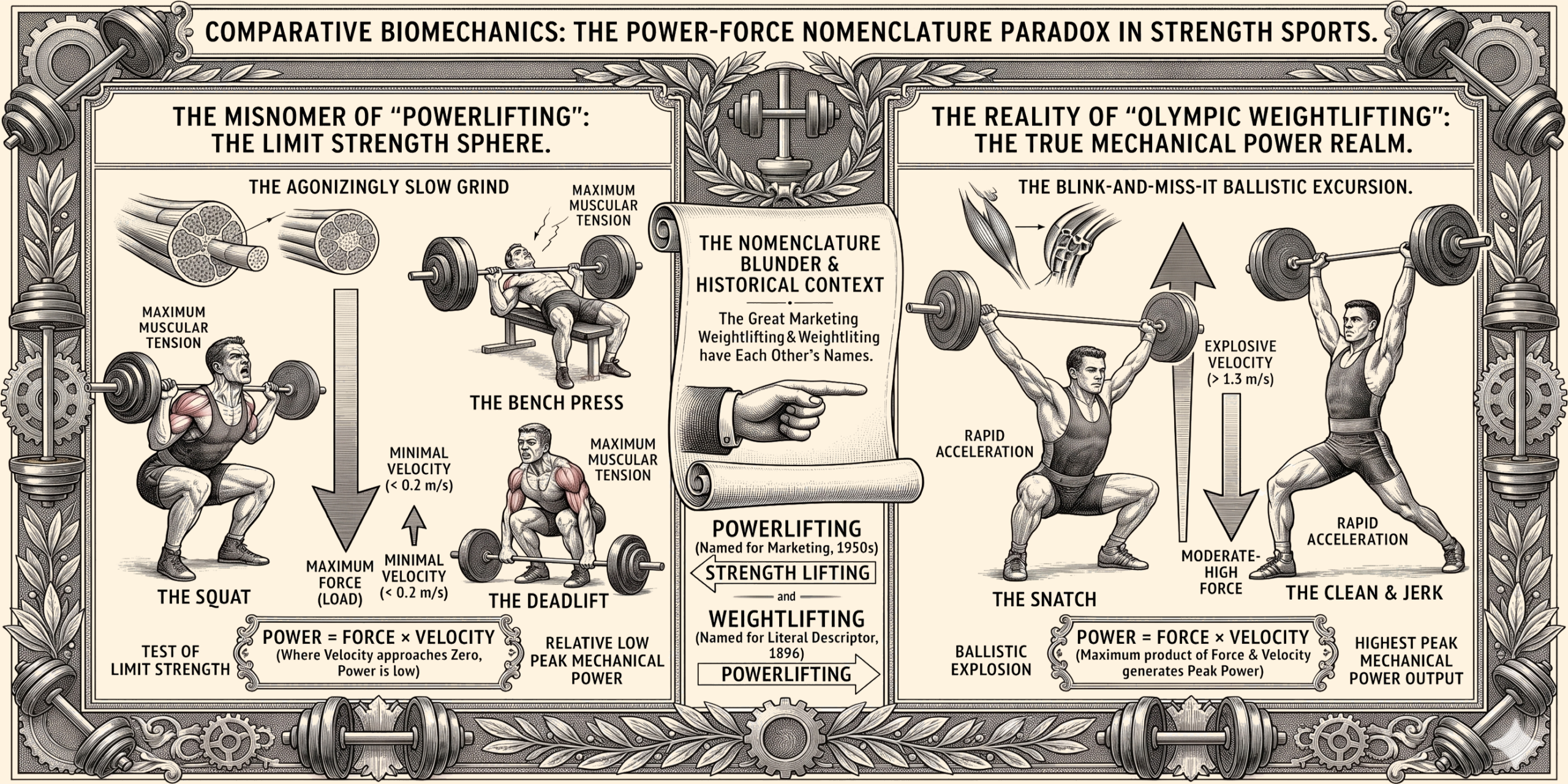
If you look at the actual biomechanics and mechanical formulas governing strength sports, you will find a hilarious historical irony. The names of our two premier barbell sports are completely inverted. What we call “weightlifting” is actually powerlifting, and what we call “powerlifting” is actually limit strength lifting.
To understand why, we have to look at the law of physics that rules the weight room: the Force-Velocity Curve.
The Math Behind the Myth: Force vs. Power
In physics, mechanical power isn’t just a generic word for being strong. It has a strict mathematical formula:
Power = Force × Velocity
- Force is the amount of absolute muscular tension required to move a mass (represented by how heavy the barbell is).
- Velocity is the speed at which that mass is moved.
To achieve maximum power output, an athlete must find the optimal intersection of both variables. If the weight is too heavy, velocity drops to near zero, and power output tanks. If the weight is too light, velocity is high, but force is too low, and power output tanks again.
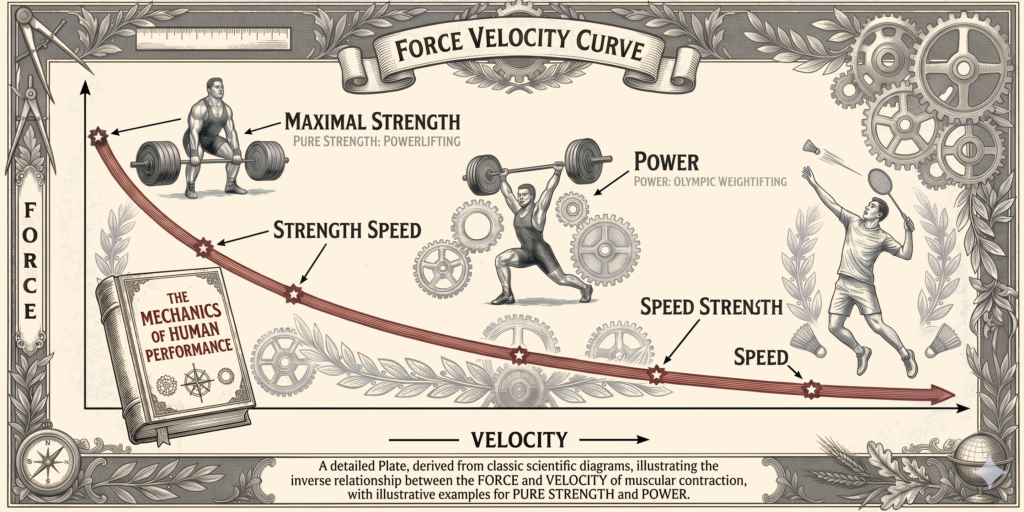
When we map Olympic weightlifting and modern powerlifting onto this curve, the naming contradiction becomes instantly clear.
1. “Powerlifting” is Actually Limit Strength Lifting
The sport of powerlifting consists of three contested movements: the back squat, the bench press, and the deadlift. The goal is simple—move the absolute maximum amount of weight possible for a single repetition.
Because the external load is at its absolute peak (a true 1-Repetition Maximum), execution velocity is incredibly low. During a maximal grind on a heavy squat or deadlift, the barbell often travels at speeds well below 0.5 m/s, sometimes crawling as slowly as 0.15 m/s as the lifter fights through a sticking point.
Because velocity approaches zero in the equation Power = Force × Velocity, the actual peak mechanical power output generated during a powerlift is relatively low compared to ballistic sports.
Powerlifting sits squarely at the top-left peak of the Force-Velocity curve. It is a test of Absolute or Limit Strength, not mechanical power.
2. Olympic “Weightlifting” is True Power Lifting
In the other corner, we have Olympic weightlifting, which consists of the snatch and the clean & jerk.
Unlike the slow grinds of powerlifting, Olympic lifts are entirely ballistic. If an athlete cannot accelerate the barbell fast enough to throw it upward and catch it, the lift fails completely. Gravity will win before the lifter can slide underneath the bar.
Because of this limitation, Olympic lifters cannot handle the same raw, absolute loads that powerlifters can. However, their execution velocity is staggering. Peak barbell velocities in the snatch and clean & jerk routinely reach anywhere from 0.75 m/s up to and exceeding 1.3 m/s.
By combining massive force expressions with high-speed execution, Olympic weightlifters generate some of the highest peak mechanical power outputs of any athletes on earth—bridging the Strength/Speed and Speed/Strength zones of the curve.
If we went strictly by the physics definition, Olympic weightlifting is the true embodiment of “power lifting.”
How Did the Names Get Swapped?
If the physics are so clear, how did the fitness world get it so wrong? The confusion is entirely historical, not scientific.
“Weightlifting” was simply the literal descriptor adopted when the sport entered the modern Olympic Games in 1896. At the time, sports biomechanics did not exist as a formalized discipline; they were simply lifting heavy weights on a global stage.
Decades later, in the 1950s and 1960s, a new subculture of lifters emerged who focused on the “odd lifts”—the squat, bench press, and deadlift. When they broke away from the Olympic federations to create their own competitive format, they needed a distinct, punchy title to market their sport to the public and differentiate themselves from the clean and snatch.
“Powerlifting” was chosen for its marketing appeal and commercial ring, completely detached from the literal physics of the movements.
The Verdict
If sports scientists were in charge of naming rights today, the rulebook would be rewritten:
- The Squat, Bench, and Deadlift would belong to the sport of Strength Lifting.
- The Snatch and Clean & Jerk would belong to the sport of Powerlifting.
The next time you watch a lifter spend five agonizing seconds grinding out a heavy deadlift max, admire their absolute strength—but remember that the true power is found in the blink-and-you’ll-miss-it speed of an Olympic snatch.