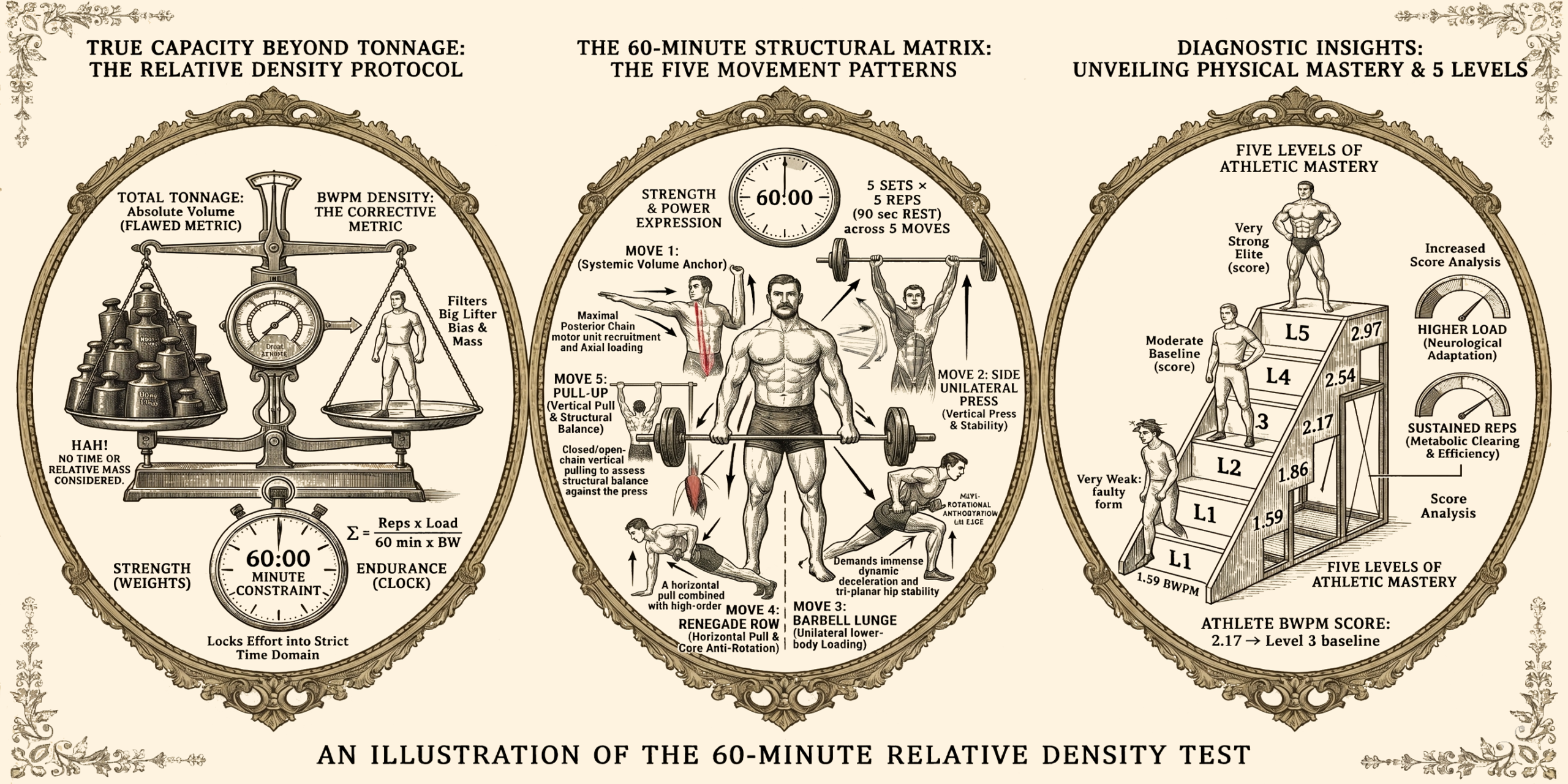
In strength and conditioning, absolute volume (sets × reps × load) is a deeply flawed metric when viewed in isolation. A 110 kg athlete moving 10,000 kg of total tonnage over an unstructured, two-hour session appears dominant on paper. However, this metric completely ignores two critical variables: time and relative body mass.
I developed this testing methodology in 2011 out of a practical necessity to bridge this diagnostic gap. My goal was to create a definitive, unbiased system that could accurately compare the strength-power-endurance profiles of completely different athletes on equal terms—allowing a coach to evaluate a lightweight, highly explosive competitor against a heavyweight lifter without absolute strength bias. By filtering out raw mass and locking the entire effort into a strict time domain, this protocol isolates who can actually maintain the highest relative power output under cumulative metabolic stress.
Over fifteen years of practical application, this 60-minute diagnostic baseline has proven its worth. It forces athletes to express high-threshold motor unit recruitment under an uncompromising metabolic countdown, measured cleanly as Body Weight Per Minute (BWPM).
The Mathematics of Relative Density
The BWPM metric eliminates the “big lifter bias” by converting raw tonnage into a precise unit of measurement: body weights moved per minute across a standard hour.
THE BWPM DENSITY FORMULA:
BWPM Density = (Total Repetitions × Weight Lifted in kg) ÷ (60 Minutes × Athlete’s Body Weight in kg)
By maintaining a fixed 60-minute denominator, the formula introduces a rigid constraint. Shorter sessions compress time and mask the fatigue curve, allowing the phosphagen and fast glycolytic systems to carry the load. A strict 60-minute framework ensures that the data captures the accumulation of systemic fatigue, revealing whether an athlete can sustain neural drive when homeostatic markers decline.
The Testing Protocol: The 5×5 Structural Matrix
The test consists of 5 sets of 5 repetitions across five specific, full-body movements. The rest interval is strictly fixed at 90 seconds.
To accurately capture the mechanical work performed during unilateral movements, every individual limb execution is counted as a repetition (e.g., 5 reps per side equals 10 repetitions for the set). This accounts for the increased time-under-tension and mechanical output required by one-sided variations.
The Five Movement Patterns
- The Standard Deadlift (Olympic Bar): The systemic volume anchor, testing maximal posterior chain motor unit recruitment and axial loading.
- The Side Press (Unilateral Standing Vertical Press): Tests vertical pushing power integrated with deep lateral chain stabilization (quadratus lumborum and obliques).
- Weighted Pull-Up / Lat Pulldown: Closed/open-chain vertical pulling to assess structural balance against the press.
- Barbell Lunges (Olympic Bar): Unilateral lower-body loading that demands immense dynamic deceleration and tri-planar hip stability.
- Renegade Row (Dumbbells): A horizontal pull combined with high-order anti-rotational core demands.
The 5 Levels of Athletic Mastery
To establish objective benchmarks across diverse weight classes, the system utilizes a geometric classification scale based on a 17% coefficient between tiers (Level N = Level N-1 × 1.17).
The anchor for this system is Level 3 (Moderate), which represents a balanced, well-conditioned amateur athlete. For a baseline 70 kg athlete, Level 3 is achieved by successfully completing the 60-minute matrix using the following working weights: Deadlift (95 kg), Side Press (20 kg), Pull-Up/Pulldown (60 kg), Lunges (60 kg), and Renegade Row (25 kg). This yields a total session volume of 9,125 kg, translating to a target baseline of 2.17 BWPM.
Coaches can evaluate their athletes using the following five performance tiers:
- L1: Very Weak (Target: 1.59 BWPM) — Characterized by underdeveloped systemic conditioning or severe relative strength deficits. Structural leaks dominate unilateral movements.
- L2: Weak (Target: 1.86 BWPM) — The structural base is present, but metabolic buffering capacities fail past the 30-to-40 minute mark.
- L3: Moderate (Target: 2.17 BWPM) — The Standard Benchmark. Displays high structural balance, competent intra-set recovery, and efficient movement mechanics.
- L4: Strong (Target: 2.54 BWPM) — Highly conditioned. Features advanced motor unit synchronization and exceptional mitochondrial efficiency to sustain output under fatigue.
- L5: Very Strong (Target: 2.97 BWPM) — Elite / Olympic Class. The athlete moves nearly 3 times their body weight every minute for 60 minutes, representing peak human physical mastery.
The Power of the Scale: Because the scale is geometric rather than linear, the performance jumps become wider as the levels increase. This perfectly mirrors the law of diminishing returns in elite sports performance; moving from L4 to L5 requires a massive leap in neuro-metabolic efficiency compared to moving from L1 to L2.
The Scientific Framework
The elegance of this test lies in how it forces conflicting physiological pathways to resolve under pressure.
1. High-Threshold Motor Unit Recruitment Without Failure
The protocol utilizes a working load of 5 clean repetitions per set, typically aligning with an intensity of 75% to 85% of 1RM. According to Henneman’s Size Principle, motor units are recruited in an orderly fashion from smallest to largest based on force demands.
Loading at greater than 75% ensures the immediate recruitment of high-threshold, fast-twitch Type IIx and IIa motor units—the fibers responsible for athletic power and maximum force production. Because the protocol mandates clean repetitions, sets are terminated before absolute structural breakdown occurs, ensuring that every unit of density calculated represents high-quality neurological output rather than compensatory “junk volume.”
2. Bioenergetic Substrate Clearing and Incomplete Recovery
A 90-second rest interval sits at a critical physiological intersection. Full resynthesis of intramuscular Adenosine Triphosphate (ATP) and Phosphocreatine (PCr) requires roughly 3 to 5 minutes of passive rest. At 90 seconds, PCr stores are only partially restored (approximately 85-90%).
As the 25 sets progress across the hour, the athlete cannot rely purely on the phosphagen system. They are forced to utilize fast glycolysis, causing a rapid accumulation of hydrogen ions and inorganic phosphate, which drops intramuscular pH.
The test directly measures the athlete’s ability to buffer this acidity and maintain neural output. An athlete with an underdeveloped aerobic conditioning base or poor mitochondrial efficiency will experience a drop-off—either failing to hit the 5 clean reps or requiring more than 90 seconds of rest, both of which heavily penalize the final score.
3. Structural Integrity and Anti-Rotation
By embedding three highly unilateral movements (Side Press, Lunges, Renegade Row) into a heavy density circuit, the test evaluates the “leakage” of kinetic energy. The unilateral variations drastically increase the time-under-tension per set (up to 60 seconds compared to 15 seconds for bilateral lifts).
During a heavy Renegade Row or Side Press, the anti-rotational demand on the transverse abdominal wall and deep spinal stabilizers is immense. If the core redlines before the prime movers do, form breaks, the set terminates, and the density score reflects the structural weak link.
Diagnostic Application: Reading the Score
Because the parameters (reps, rest, movements) are rigid constants, a change in an athlete’s relative density score over a macrocycle points to a highly specific physiological adaptation:
- Increased Score via Higher Load (Neurological Adaptation): The athlete has increased their absolute 1RM or enhanced motor unit synchronization. This means their 75-85% intensity zone now represents a higher absolute mass shifted per minute, raising the overall density.
- Increased Score via Sustained Reps (Metabolic Efficiency): The athlete has optimized their intra-set recovery and clearing pathways. They display an advanced strength-endurance exponent by successfully resisting the accumulation of hydrogen ions and maintaining clean execution for all 5 reps deep into the 60-minute block.
Ultimately, this protocol bridges the gap between pure strength and metabolic conditioning. It provides coaches with a clean, unbiased metric that proves whether an athlete is building true, useful Physical Mastery—or simply taking longer breaks to move heavy iron.
Foundational Literature & Scientific References
- On Motor Unit Recruitment & Intensity (75-85%): Henneman, E., Somjen, G., & Carpenter, D. O. (1965). Functional Significance of the Size of Motor Neurons. Journal of Neurophysiology. (Validates that loads above 75% are biologically required to immediately force the central nervous system to recruit high-threshold, explosive Type II muscle fibers).
- On Energy System Recovery & the 90-Second Rest Window: Harris, R. C., Edwards, R. H., & Hultman, E. (1976). The time course of phosphorylcreatine resynthesis during recovery of the quadriceps muscle in man. Pflügers Archiv. (Maps out how a 90-second rest interval forces incomplete ATP-PCr recovery, triggering the fast-glycolytic pathway and testing an athlete’s metabolic clearing rate).
- On Strength-Endurance and Fatigue Cumulative Dynamics: Zatsiorsky, V. M., & Kraemer, W. J. (2006). Science and Practice of Strength Training (2nd ed.). Human Kinetics. (Validates how cumulative structural fatigue alters motor unit synchronization and why managing the fatigue curve across a fixed time block is essential for true athletic profiling).
- On Unilateral Structural Demand & Anti-Rotation: McGill, S. M. (2002). Ultimate Back Fitness and Performance. Waterloo. (Proves that unilateral loaded movements and anti-rotational exercises impose immense reflexive neural demands on the core that traditional bilateral lifting misses).