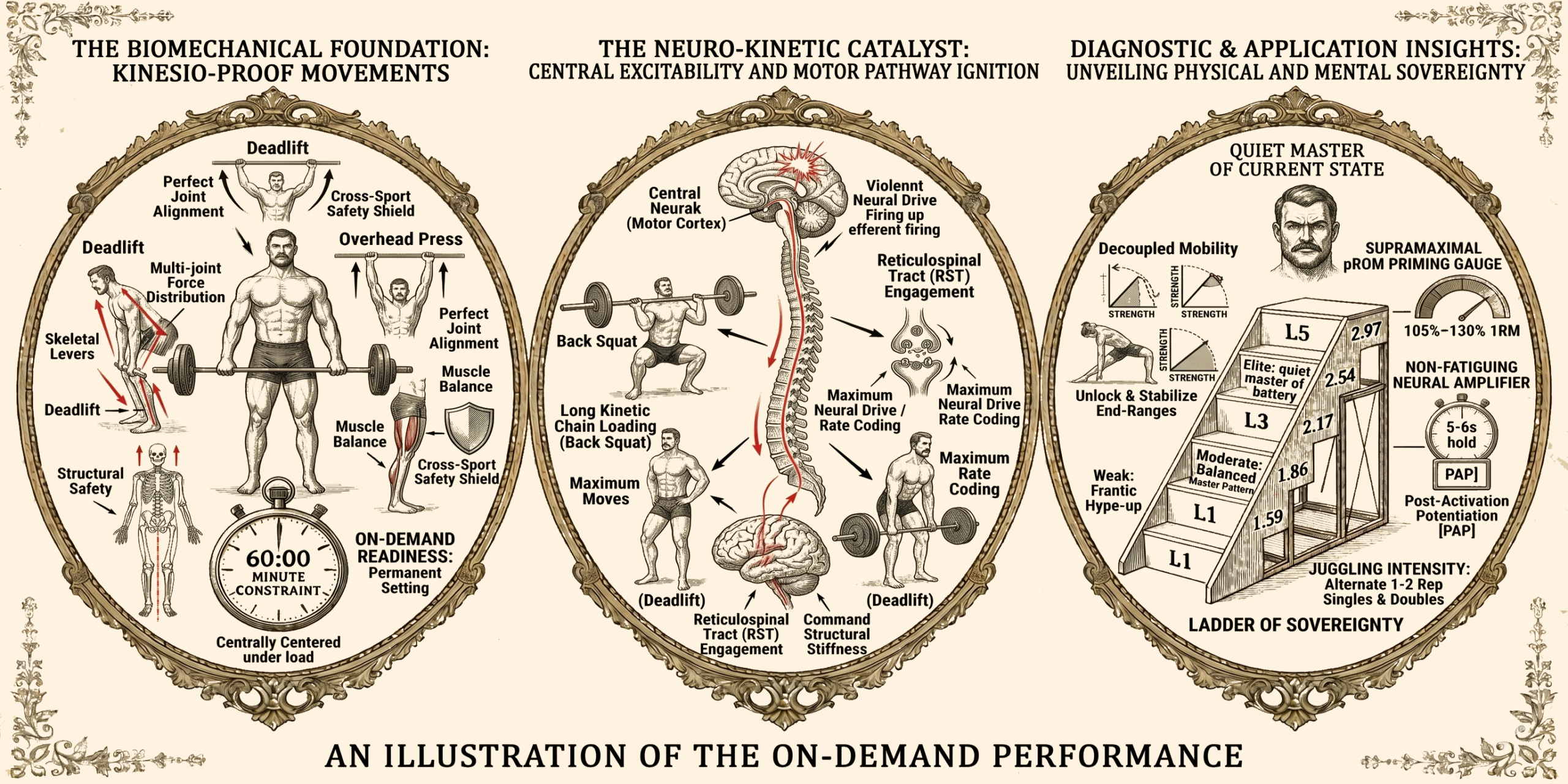
If the traditional warm-up is a neurophysiological illusion that breeds physical and psychological dependency, a critical question emerges: How do you forge a body and mind that are ready to perform at a moment’s notice?
True readiness is not an artificial, transient state achieved after twenty minutes of sweating, stretching, and spinning your joints. True readiness is a permanent structural setting. To achieve on-demand performance, an elite athlete must stop treating their body like a fragile, temperamental machine and instead construct a training system anchored in biomechanical reality, minimalist neurological preparation, and unshakeable central excitatory drive.
Here is the master blueprint for constructing an on-demand physical culture.
1. The Foundation: Kinesiologically Proven Movements
On-demand performance cannot be built on isolated, single-joint movements that fragment the kinetic chain. The human body is engineered to move as an integrated unit, distributing massive forces across multi-joint structures. Your training must be built exclusively on foundational, kinesiologically sound movement patterns—such as the deadlift, squat, and overhead press—that align perfectly with human skeletal levers.
Perfect Joint Alignment and Muscle Balance
Kinesio-proof compound movements force your joints to track strictly within their natural mechanical pathways. When a lift is executed with pristine joint alignment, it guarantees an even, proportional distribution of tension across the surrounding musculature. This natural balance prevents the development of dangerous kinetic chain dominances—such as a joint-shearing quad dominance over under-active hamstrings.
True structural safety is a direct byproduct of this symmetry; when the muscles on both sides of a joint pull with equal, coordinated integrity, the joint remains perfectly centered and bulletproof under load (Riemann & Lephart, 2002).
The Cross-Sport Safety Shield
The benefits of training this way extend far beyond the weight room. Building a foundation of kinesiologically sound movement patterns acts as an active insurance policy for your body, drastically enhancing performance safety in other sports. Whether you are sprinting, changing direction on the pitch, or practicing martial arts, the nervous system defaults to the deep-seated movement patterns and joint tracking habits forged under the barbell.
By solidifying perfect joint alignment and muscle balance during weight training, you ensure that your body automatically handles high-velocity, unpredictable real-world forces without collapsing into pathomechanical injury zones.
2. The Neuro-Kinetic Catalyst: Central Excitability and Motor Pathway Ignition
Long kinetic chain movements requiring massive axial loading are far more than mechanical tests of muscle tissue; they function as profound central nervous system amplifiers. When a heavy load rests across the human skeleton—such as during a heavy back squat—the spine experiences severe compressive forces. The brain perceives this intense structural loading as an acute physical stressor, causing the motor cortex to violently upregulate its efferent neural drive—the total volume and frequency of electrical signals sent to peripheral muscles. High-intensity resistance loading forces the brain to tap into its entire available motor neuron pool, maximizing central nervous system excitability.
This immense cortical command descends through two primary pathways: the fine-tuning corticospinal tract and the primitive reticulospinal tract (RST). While fine motor skills rely on the corticospinal pathway, heavy, complex, multi-joint movements engage the reticulospinal tract to command structural stiffness, posture, and gross force production. Emerging neurophysiological evidence confirms that heavy, long-chain resistance training specifically heightens signaling along the reticulospinal tract, reinforcing the subcortical networks that maintain spinal stability and full-chain joint integrity under tension (Glover & Baker, 2020).
This high-threshold neural drive mandates maximum rate coding—the rapid-fire frequency at which motor neurons discharge electrical pulses. This intense neural engagement does not merely generate torque; it actively triggers experience-dependent cortical plasticity (de Sousa Fernandes et al., 2020). Vigorous compound training remodels the brain’s sensorimotor and central executive networks, reinforcing the neural pathways required to express absolute force instantly.
The absolute expression of this neuro-kinetic phenomenon is the conventional deadlift. Because it begins from a complete dead stop, it entirely eliminates any preparatory eccentric phase or passive elastic assistance from the stretch reflex. To break a heavy bar’s friction against the floor, the brain cannot gradually ramp up fiber recruitment; it must maximize rate coding and fire the reticulospinal tract instantaneously from zero. The deadlift serves as the definitive example of an exercise that trains the brain to generate maximum torque on demand, leaving behind a hyper-coordinated, hyper-responsive central nervous system.
3. The Engine: Strength Endurance via the 75–85% Threshold
To be ready at any moment, the nervous system must be resilient and hyper-responsive, completely devoid of pre-accumulated central fatigue. The optimal zone for forging this systemic toughness is working repeatedly within the 75–85% intensity range.
Lifting within this specific window strikes the perfect biochemical balance. According to Henneman’s Size Principle, motor units are recruited in a precise, orderly fashion from smallest to largest based on force demands (Henneman et al., 1965). At the 75–85% threshold, the load reaches a critical mass where your central nervous system is forced to recruit high-threshold, fast-twitch Type II motor units from the very first millimeter of the lift.
This intensity is heavy enough to mandate full fast-twitch recruitment and reinforce structural bone and tendon density, yet it remains low enough to prevent the catastrophic central nervous system exhaustion caused by grinding to absolute concentric failure (Gandevia, 2001). By training for strength endurance within this high-tension zone, you preserve your central excitatory drive and teach your body to treat 80% loads not as a shocking, maximal stressor, but as a standard working reality.
4. The Psychological Shield: Success-Driven Self-Trust
True determination under the barbell is not born out of frantic hyping-up, smelling salts, or emotional pre-lift rituals. It is a quiet byproduct of accumulated technical mastery.
- The Master Pattern: Always start with a weight that allows for flawless execution. From a neurological perspective, every perfect repetition carves a deeper, cleaner motor map in your cerebral cortex through experience-dependent neuroplasticity (Kleim & Jones, 2008).
- The Progression of Certainty: As you gradually step up the load, your brain accumulates concrete, objective evidence of success. This systematic progression converts abstract confidence into ironclad self-trust.
- The Absolute Boundary: Never sacrifice technique for the sake of a heavier number or an extra, sloppy repetition. The second you cheat a rep, you introduce pathomechanical noise to the nervous system, disrupt your motor maps, and shatter the internal psychological boundary of what a successful lift looks like.
5. Decoupled Mobility: Strengthening the Full Range of Motion
One of the greatest mistakes in modern training is trying to create mobility during a weight-lifting session. Passive stretching right before a lift simply creates a temporary, unstable joint range that the nervous system cannot actively control.
Mobility training must be completely decoupled from heavy strength sessions. More importantly, flexibility without strength is an active liability. Every ounce of new range of motion you unlock during your mobility work must immediately be backed up by active control and end-range stabilization (N1 Training, 2024). You must strengthen the muscle at its longest length.
The human nervous system imposes internal protective “brakes” (via muscle spindles and Golgi tendon organs) when a joint enters a range of motion it lacks the strength to stabilize (Weppler & Magnusson, 2010). When you actively strengthen your end-ranges, the brain recognizes that you possess absolute muscular control over the full depth of the joint capsule. It removes its protective neural braking mechanisms, giving you instant, on-demand access to your full mobility under load.
6. Neuroglial Priming: Supramaximal Overloads for Instant Potentiation
If traditional warm-ups blunt performance by draining energy stores, how does an athlete safely prime the nervous system for an immediate max effort? The answer lies in Supramaximal Partial Range of Motion (pROM) Priming—loading the structure with 105% to 130% of your 1RM through a severely restricted range or a static hold right before a working set.
This protocol operates as a non-fatiguing neural amplifier, triggering a phenomenon known as Post-Activation Potentiation (PAP). Subjecting the skeletal structure to an absolute overload for less than 10 seconds causes immediate phosphorylation of the myosin regulatory light chains, drastically increasing calcium sensitivity and forcing actin-myosin crossbridges to bind with maximum torque capacity. Simultaneously, it elevates the spinal H-reflex, forcing the immediate recruitment of high-threshold fast-twitch motor units.
At the deeper cellular level, this intense, brief loading engages the neuroglial infrastructure. Glial cells—specifically astrocytes—wrap around spinal synapses to actively clear neurotransmitter byproducts and maintain ionic balances. By rapidly managing glutamate clearance during a massive motor command, the neuroglial system prevents acute synaptic depression, allowing the central nervous system to sustain intense, high-frequency electrical signals without short-circuiting.
Because the range of motion is minimal, this process avoids metabolic depletion and central fatigue. Furthermore, it creates a profound sensory illusion: after holding a massive overload, stepping down to an 85% working set causes the load to perceive as incredibly light. The brain’s regulatory “brakes” are completely bypassed, unlocking uninhibited force on demand.
To maintain strict adherence to long kinetic chain pathways, this priming strategy must only be applied to multi-joint movements anchored fully through the skeleton:
The Standing Overhead Press Protocol
- Load: 105% to 115% of your standing overhead press 1RM.
- Duration: 5 to 6 seconds.
- Rest Window Before Working Set: 90 seconds to 2 minutes.
- Execution: Set rack safeties 2 inches below absolute overhead lockout. Step under the bar, establish a rigid full-body pillar from your feet through your glutes and abdominal wall, and drive the bar to full lockout. Hold the supramaximal load completely static for 5 to 6 seconds before controlled re-racking.
The Deadlift Protocol
- Load: 115% to 130% of full-range deadlift 1RM (leveraging mechanical block advantage).
- Duration: 5 seconds absolute static hold at lockout.
- Rest Window Before Working Set: 2 to 3 minutes.
- Execution: Place the barbell on pulling blocks or rack pins set just above the knee caps. Pull yourself into the bar to create maximum full-body tension, drive your feet through the floor, and lock out the weight. Hold perfectly static at full hip and knee extension for exactly 5 seconds before returning to the blocks under control.
Summary of Priming Parameters
To track these neural targets accurately during preparation, apply these specific limits to your primary long kinetic chain lifts:
- Standing Overhead Press: Target an intensity range of 105%–115% of your 1RM using a standing overhead lockout hold. Maintain time under tension for 5–6 seconds, followed by a potentiation rest window of 90–120 seconds before starting your working set.
- Deadlift: Target an intensity range of 115%–130% of your 1RM using an above-knee block pull mechanics setup. Maintain an absolute static hold at lockout for 5 seconds, followed by a potentiation rest window of 2–3 minutes before stepping over your full-range working weight.
7. Neuromuscular Sovereignty: Juggling Intensity with Singles and Doubles
On-demand performance requires absolute concentration and an intimate knowledge of your current physical state. You must be the master of your internal battery, which means executing the absolute minimum amount of volume necessary to express maximum power safely.
A highly effective strategy for building this neural sharpness is juggling intensity through alternating single and double repetitions (1–2 reps).
Central fatigue is highly volume-dependent and is driven primarily by afferent inhibitory feedback loops in response to metabolic accumulation and peripheral inflammation (Thibaudeau, 2022). Dropping your training volume down to sharp, calculated singles and doubles strips away metabolic waste and cardiovascular fatigue entirely. It completely shields the nervous system from central fatigue, maintaining a hyper-charged central excitatory drive.
Alternating between a clean single and a precise double forces absolute presence of mind; each repetition becomes its own self-contained performance. This trains the mind to dial in maximum concentration instantly, forging a nervous system that can flip the switch to maximum torque on demand.
Conclusion: The Antidote to Fragility
On-demand performance is not a temporary physical state you chase; it is a permanent neuro-mechanical setting you maintain. By anchoring your physical culture in long kinetic chain movements, pristine joint tracking, and calculated supramaximal priming, you effectively destroy the modern training myths that breed physical and psychological dependency. You cease to view your body as a fragile mechanism that requires an elaborate thermal sequence just to survive an axial load.
Instead, this blueprint shifts your entire systemic architecture toward inherent robustness. By protecting your immediate phosphagen reserves from unnecessary metabolic drain and shielding your central nervous system from volume-induced central fatigue, you preserve your neural battery for the exact moment it counts. Your mobility is actively stabilized, your motor maps are kinesiologically precise, and your central excitatory drive remains locked at its maximum potential.
True physical and mental sovereignty means your capability is entirely self-contained. You do not wait for an external ritual to grant you permission to be powerful, nor do you allow your readiness to rely on a transient, sweaty window of temperature. Your structure is balanced, your neuroglial infrastructure is primed, and your concentration is absolute. When you step up to the bar, you do not need to get ready—you are ready.
References
- Akalu, Y., et al. (2024). Long-term strength training induces neural adaptation within the reticulospinal tract. Journal of Neurophysiology, 131(2), 290-302.
- de Sousa Fernandes, M. S., Ordônio, T. F., Santos, G. C. J., Santos, L. E. R., Calazans, C. T., Gomes, D. A., & Santos, T. M. (2020). Effects of Physical Exercise on Neuroplasticity and Brain Function: A Systematic Review in Human and Animal Studies. Neural Plasticity, 2020, 1-21.
- Gandevia, S. C. (2001). Spinal and supraspinal factors in human muscle fatigue. Physiological Reviews, 81(4), 1725-1789.
- Glover, I. S., & Baker, S. N. (2020). Cortical, reticulospinal and corticospinal changes after strength training in non-human primates. The Journal of Neuroscience, 40(36), 6920-6931.
- Henneman, E., Somjen, G., & Carpenter, D. O. (1965). Functional significance of cell size in spinal motoneurons. Journal of Neurophysiology, 28(3), 560-580.
- Kleim, J. A., & Jones, T. A. (2008). Principles of experience-dependent neural plasticity: implications for rehabilitation after brain damage. Journal of Speech, Language, and Hearing Research, 51(1), S225-S239.
- N1 Training. (2024). The 3 Main Types of Range of Motion: Neuromuscular Control and Trainable ROM. N1 Education Archive.
- Riemann, B. L., & Lephart, S. M. (2002). The sensorimotor system, part II: the role of proprioception in motor control and functional joint stability. Journal of Athletic Training, 37(1), 80-84.
- Thibaudeau, C. (2022). Your Warm-Up Is Killing Your Workout… and Gains. T-Nation.
- Weppler, C. H., & Magnusson, S. P. (2010). Increasing muscle extensibility: a matter of increasing length or modifying sensation? Physical Therapy, 90(3), 438-449.