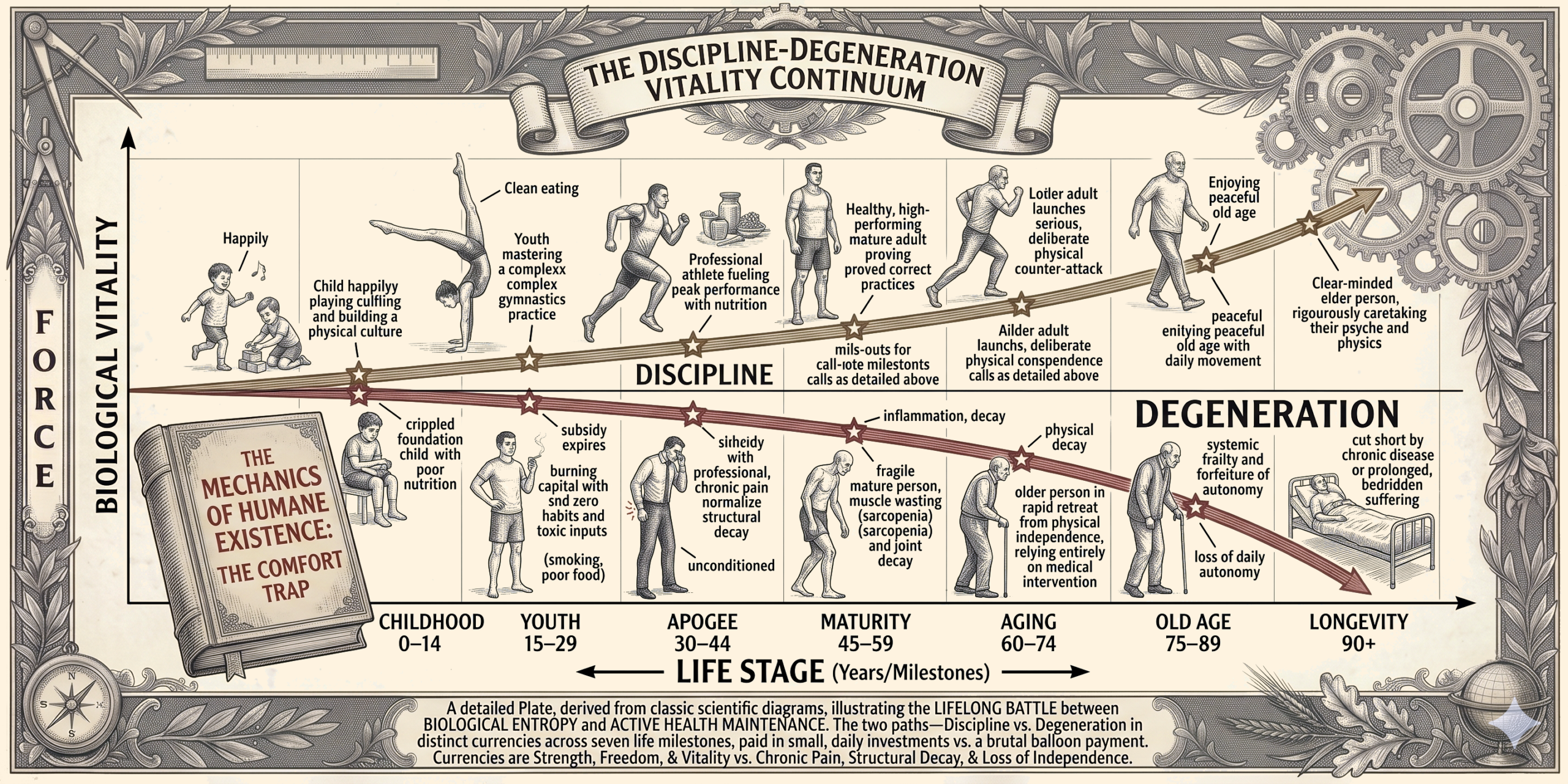
When observing people in everyday public spaces—like a crowded beach or a busy city square—it is easy to notice a massive collective misunderstanding of human biology. Many treat health as if it were a static property, a baseline status they naturally possess until a medical crisis occurs. They indulge in physical stagnation, toxic habits, and poor nutrition, operating under the flawed assumption that “doing nothing” simply keeps their physical state in neutral.
This is a catastrophic miscalculation.
Health is never a static shield; it is an active, lifelong process. It is a dynamic state of equilibrium that requires continuous, conscious energy input. The moment an individual stops actively generating health, they do not stand still—they immediately surrender to biological entropy.
To understand the choices we make, we must look at the two distinct trajectories—Discipline versus Degeneration—across the full chronological timeline of human life.
The Seven Lifelong Biological Milestones
1. Childhood (Ages 0–14)
Childhood is the critical period where the physical body is built and the foundations of health are laid down for decades to come.
- The Active Process of Discipline: This stage requires an abundance of valuable nutrients alongside constant movement and play. It is the time to build a robust physical culture, identify structural strengths and preferences, and establish a sport that the child genuinely enjoys.
- The Passive Path of Degeneration: Neglecting this stage by allowing sedentary habits and nutrient-poor foods cripples the human foundation before the structural frame is even fully formed.
2. Youth (Ages 15–29)
During youth, the human body possesses massive biological resilience. It heavily subsidizes poor choices because cellular repair is highly efficient, allowing people to enjoy natural health without actively investing in it.
- The Active Process of Discipline: The disciplined individual uses this period to consciously realize their interests and turn them into physical strengths. They learn and master the specific practices required to maintain long-term physical health, using sports as a source of pleasure that accompanies complete self-care.
- The Passive Path of Degeneration: Most people spend this biological grace period burning through their inherited capital, establishing zero structural habits because the body forgives toxic inputs for a few short years.
3. Apogee (Ages 30–44)
This is the stage of a person’s most distinct personal and professional expression. It is the unique evolutionary intersection where youth and hard-earned life experience ally.
- The Active Process of Discipline: High-quality nutrition and targeted physical training directly support and fuel this demanding life peak, ensuring that energy output matches professional and personal ambitions.
- The Passive Path of Degeneration: Without active maintenance, the biological subsidy completely expires. Metabolic flexibility drops, structural degradation begins, and chronic pain is falsely normalized as a standard symptom of getting older.
4. Maturity (Ages 45–59)
Maturity is the ultimate point of biological truth. During this phase, an individual reaps exactly what they sowed over the preceding three conscious decades of life.
- The Active Process of Discipline: Maintaining excellent health, high performance, and vitality during this period serves as solid proof that an individual has mastered correct physical practices, eats exceptionally well, and exercises sufficiently.
- The Passive Path of Degeneration: For the uninvested, this phase marks the onset of rapid muscle wasting (sarcopenia), joint decay, and metabolic dysfunction. They are forced to live inside a fragile, failing structure.
5. Aging (Ages 60–74)
After the age of sixty, physical and biological decline becomes distinctly more visible and aggressive.
- The Active Process of Discipline: Rather than surrendering to age, this is the exact moment to launch a deliberate counter-attack! It is the time to introduce even more serious measures and additional targeted practices to actively reinforce and protect physical health.
- The Passive Path of Degeneration: This period becomes a rapid retreat from physical independence, as individuals who avoided discipline become passive onlookers in their own physical decay, relying entirely on medical intervention to survive.
6. Old Age (Ages 75–89)
The consequences of one’s lifelong relationship with their body culminate in old age.
- The Active Process of Discipline: Those who maintained an active lifestyle and executed a successful counter-attack earn a peaceful old age entirely free of debilitating illnesses. Vitally important to this stage is daily physical movement, alongside a highly specific nutritional strategy. The diet must include a complete mineral-vitamin complex, sufficient high-quality protein, and plenty of animal fats and cholesterol. Statistical data clearly indicates that older individuals who maintain higher cholesterol levels enjoy longer lives and vastly superior health.
- The Passive Path of Degeneration: This stage is defined by systemic frailty, severe loss of motor control, and the complete forfeit of basic daily autonomy.
7. Longevity (Ages 90+)
Reaching true longevity while maintaining a clear mind and functional body is a rare human achievement. While genetics can play a minor role, consciousness and self-initiative remain entirely decisive for a person’s ultimate lifespan.
- The Active Process of Discipline: Modern society provides an unprecedented abundance of material goods, yet reaching functional longevity has never been more difficult. The rare individuals who thrive past ninety are those who have maintained rigorous, proper care of both their physics and their psyche for an entire lifetime.
- The Passive Path of Degeneration: Longevity is either completely cut short by chronic disease, or it is reduced to a state of prolonged, bedridden suffering.
Conclusion: There is No Free Choice
There is no free ride in a biological vehicle. The misconception of the true meaning of ‘comfort’ is a sophisticated trap.
The energy required to maintain a high-functioning body is substantial—it demands conscious nutritional choices, intense movement precision, and voluntary physical effort. But navigating the world in a broken, inflamed, and unconditioned body requires far more energy.
You can pay the price of discipline—the temporary effort of physical training, the consistency of clean eating, and the focus of an active life.
Or you can pay the price of degeneration—the chronic pain of structural decay, the loss of basic mobility, and the agonizing erosion of your independence.
One price is paid in small, daily investments that return strength, freedom, and vitality across every single stage of existence. The other is a brutal balloon payment collected at the end. Every human being pays a price; the choice of which currency to use belongs entirely to the individual.