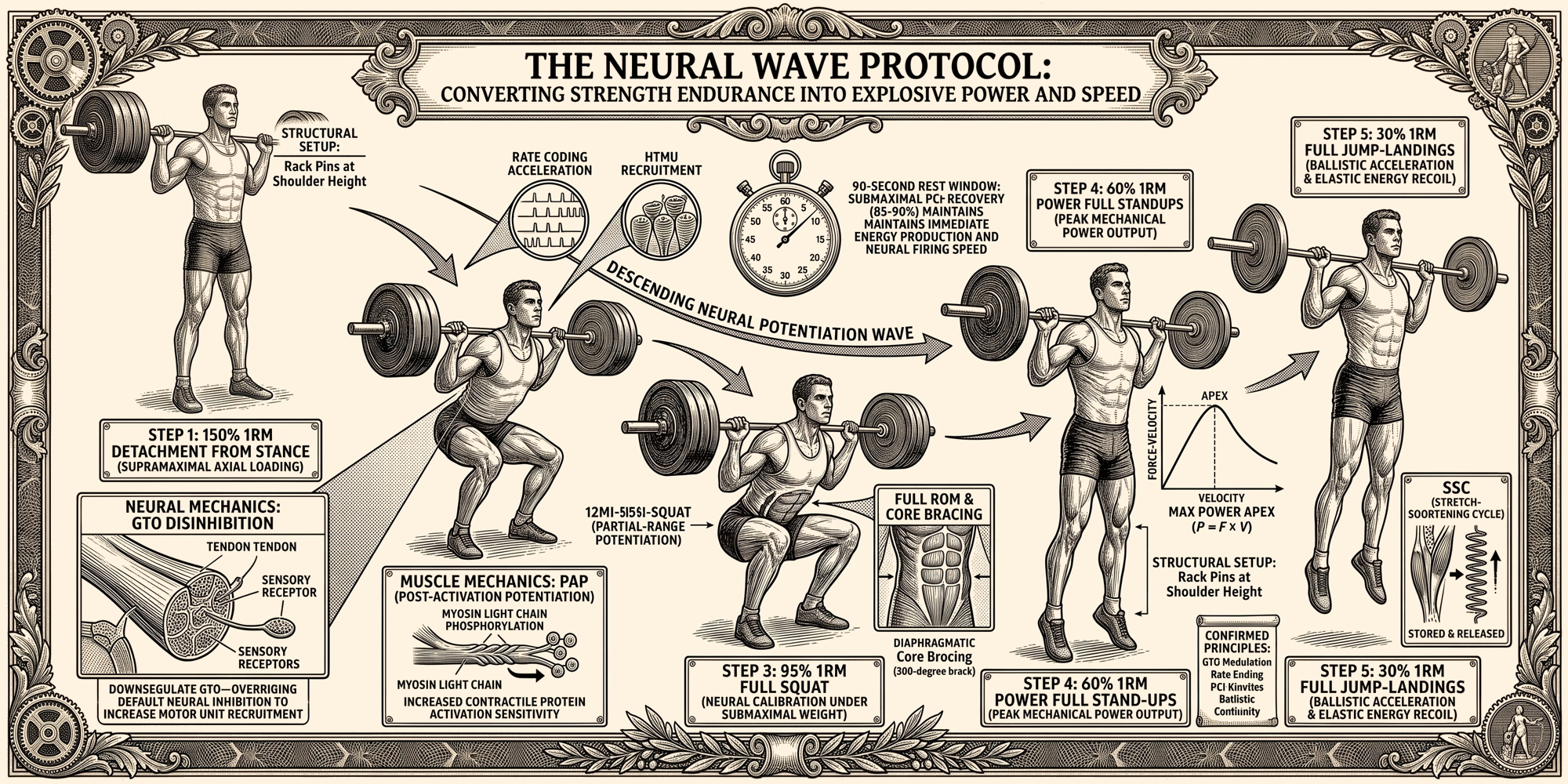
Converting baseline strength endurance into explosive power and speed requires a structured descending neural potentiation wave. Stepping down sequentially from supramaximal loads to light, ballistic movements conditions the CNS (Central Nervous System—the brain and spinal cord controlling muscular motor commands) to recruit fast-twitch muscle fibers under time-compressed conditions. High-threshold motor unit activation drives rapid force production through precise neural pathways. Systematically reducing external resistance increases movement velocity while maintaining maximum voluntary effort. This wave protocol transforms force capacity into high-speed power execution.
In practical terms, applying this wave protocol, particularly for squats, trains your nervous system to instantly translate heavy gym strength into raw, explosive athletic speed, directly increasing your jump height and length while improving your sprinting speed.
Vertical Jump Height
Maximizing rate of force development in the squat transfers directly to vertical takeoff velocity. The potentiated stretch-shortening cycle yields higher peak force at triple extension, directly raising vertical jump height.
Horizontal Jump Length
Developing explosive extension speed through deep flexion angles produces greater horizontal impulse off the ground. Higher initial propulsive forces increase distance in standing and dynamic horizontal jumps.
Sprinting Speed
Enforcing maximal voluntary intent during low-load ballistic phases reduces ground contact time during sprint acceleration. Rapid rate coding trains motor neurons to deliver peak force during short foot-strike windows, directly driving higher sprinting velocities.
The 5-Step Potentiating Wave Sequence
Step 1: 1 rep @ 150% Detachment from Stance
Unrack 150% of your 1RM (One-Repetition Maximum—the absolute maximum weight an individual lifts for a single completed repetition) from a standing stance and hold the position statically for 5 seconds. Detach the barbell safely back onto the rack pins immediately following the static hold. The axial skeleton experiences maximal mechanical loading during this hold. This static exposure establishes full structural bracing before dynamic loading begins.
Step 2: 1 rep @ 120% Semi-Squat
Lower into a semi-squat position using a load equal to 120% of 1RM. Drive upward with maximum intentional force to return to the standing position. Partial range dynamic extension bridges static axial loading with partial movement acceleration. The heavy dynamic effort engages high-threshold motor units through partial flexion angles.
Step 3: 3 x 1 rep @ 95% Full Squat
Perform three individual single repetitions using 95% of 1RM across the maximal range of motion. Execute each repetition through deep flexion down to the lowest position before driving upward. Relative to the supramaximal loads in Steps 1 and 2, a 95% load functions as a submaximal weight to the potentiated nervous system. This full-range loading initializes neural firing across deep joint angles to prepare the motor cortex for high-velocity full-range execution in Steps 4 and 5.
Step 4: 10 x 3 reps @ 60% Power Full Stand-Ups
Execute ten cluster sets of three repetitions using 60% of 1RM across the maximal range of motion. Drive upward at peak explosive velocity on every single repetition. Moving a 60% load from maximal depth at maximum intentional speed produces peak mechanical power output with elevated force emphasis. Low repetition sets preserve movement velocity across all ten repetitions.
Step 5: 10 x 3 reps @ 30% Full Jump-Landings
Perform ten cluster sets of three repetitions using 30% of 1RM as full-depth ballistic jump-landings. Achieve maximum vertical takeoff on each jump while absorbing the landing into a deep squat position. Ballistic jump mechanics maintain continuous force acceleration through takeoff. Absorbing the landing directly into deep flexion establishes elastic energy storage for subsequent jumps.
Rest Window Standard
Rest intervals remain fixed strictly at 90 seconds between every set and exercise. Maintaining this exact timing establishes the precise bioenergetic conditions required for high-density neural adaptation. Passive rest of 90 seconds controls intracellular energy resynthesis to sustain neural firing rates.
Contrast Training Dynamics
Contrast training pairs heavy resistance loads with biomechanically similar high-velocity movements within the same training session. This methodological structure exploits post-activation potentiation to acutely elevate rate of force development and movement speed.
Sequencing supramaximal loads prior to submaximal ballistic jumps drives motor unit synchronization across the working muscles. The central nervous system executes the dynamic movements under heightened neuromuscular activation, accelerating power transfer from foundational strength into high-velocity sport output.
The Force-Velocity Curve Continuum
The Force-Velocity Curve illustrates the fundamental, inverse biomechanical relationship between force production and contraction velocity within muscular performance. At the top-left apex lies Maximal Strength, where external loads are extreme and movement velocity remains minimal. Moving down along the continuum shifts through Strength-Speed, peak mechanical Power, and Speed-Strength, ending at pure Speed on the far-right axis, where external resistance drops and contraction velocity reaches its absolute maximum.
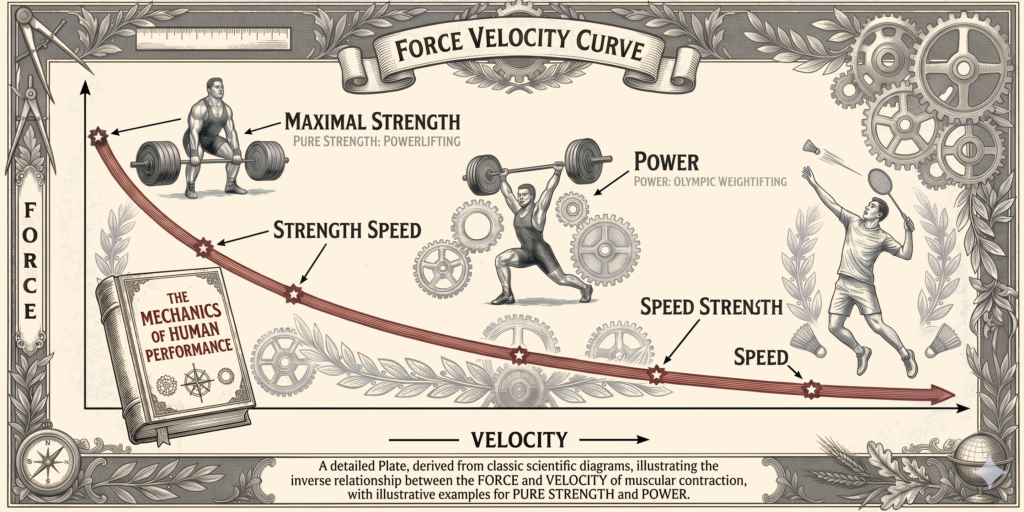
This protocol systematically traverses the entire Force-Velocity spectrum in a single training wave. Stepping down sequentially from supramaximal overload through peak mechanical power at 60% down to ballistic speed-strength at 30% bridges the gap between maximal force capacity and explosive execution. In practical terms, walking down this continuum forces the central nervous system to apply the extreme neural drive generated under heavy resistance directly to maximum-velocity athletic movements.
Core Execution Principles
Absolute Maximal Voluntary Intent on Every Positive Phase
Every positive (concentric—the upward phase of a lift where muscles contract and shorten) phase across all five steps demands 100% maximal voluntary effort. Moving heavy and submaximal loads in Steps 2 and 3 results in slow physical bar velocity due to external mass. Maximal voluntary effort forces the nervous system to maximize acceleration drive throughout the entire upward trajectory. High voluntary effort elevates central motor discharge to drive force output.
Light ballistic loading in Steps 4 and 5 translates maximal voluntary intent directly into peak movement velocity and jump height. Attempting to accelerate every concentric phase maximizes rate coding (the firing frequency of electrical impulses sent from motor neurons to muscle fibers). This voluntary electrical signal recruits HTMUs (High-Threshold Motor Units—fast-twitch muscle fiber groups responsible for maximal force production and explosive velocity). High rate coding optimizes muscle fiber synchronization during high-speed movement.
Maximal Range of Motion Execution
Steps 3, 4, and 5 require complete execution across the maximal range of motion (ROM—the entire trajectory of joint movement from deep flexion to complete extension). Working through deep joint angles recruits motor units across the entire muscle length. Deep flexion expands motor unit activation to the full movement arc. Submaximal weight initialization in Step 3 calibrates this full trajectory prior to ballistic steps.
Full ROM execution engages intra-abdominal pressure (the internal pressure created by bracing the core and diaphragm to stabilize the lumbar spine) across the entire movement path. This full-range joint loading maximizes force transmission from the lower body through the trunk. Complete joint extension delivers maximal mechanical work across the working muscle groups.
Biomechanical Mechanics Breakdown
Step 1: Supramaximal Axial Loading and Reflex Disinhibition
Unracking a load equal to 150% of 1RM subjects the axial skeleton to massive static resistance. This downregulates the GTO (Golgi Tendon Organ—a sensory receptor in muscle tendons that monitors tension and limits muscular contraction during extreme loads), overriding default neural inhibition to increase available motor unit recruitment. Suppressing this tendon reflex elevates tension thresholds across the prime movers. High axial compression primes the trunk musculature for elevated force transfer.
In practical terms, this step tricks your nervous system into feeling that heavy working weights are remarkably light, enabling you to move with maximum speed and power.
Step 2: Partial-Range Dynamic Potentiation
Moving a 120% load through a partial range creates PAP (Post-Activation Potentiation—an acute enhancement of muscular force output resulting from prior heavy loading). At the cellular level, heavy loading drives myosin light chain phosphorylation (a chemical reaction inside muscle fibers that increases the sensitivity of contractile proteins to activation). Phosphorylation increases actin-myosin cross-bridge sensitivity to calcium ions. This chemical change enhances force production during subsequent dynamic efforts.
In practical terms, moving this heavy load through a partial range supercharges your muscle fibers in motion, priming your legs to drive upward with explosive force on subsequent lifts.
Step 3: Full-ROM Neural Calibration Under Submaximal Weight
Relative to the supramaximal exposures in Steps 1 and 2, a 95% load functions as a submaximal weight to the potentiated nervous system. Executing three single repetitions through the maximal range of motion initializes the central nervous system across deep joint angles, calibrating fast-twitch motor unit firing patterns through full depth to prepare the nervous system for Steps 4 and 5. This calibration step synchronizes motor unit activation across the full joint trajectory. The submaximal load preserves neural capacity while embedding full-range movement patterns.
In practical terms, squatting through your full depth at this stage connects your newly primed explosive power to the complete movement, ensuring your muscles drive seamlessly from the very bottom position.
Step 4: Peak Mechanical Power Output
Moving a 60% load from maximal depth at 100% voluntary velocity targets the apex of the Force-Velocity relationship (P = F × v, where Power equals Force multiplied by Velocity). Executing this action across ten low-repetition cluster sets sustains high power output and maintains peak neural drive. The 60% load optimizes the balance between force generation and movement speed while emphasizing force production. Low cluster volume limits intra-set velocity loss.
In practical terms, this step hits the exact sweet spot between strength and speed, training your muscles to deliver maximum explosive drive on every single rep.
Step 5: Ballistic Acceleration and Elastic Energy Recoil
Executing full-depth jump-landings at 30% load maintains force production through takeoff. This optimizes the SSC (Stretch-Shortening Cycle—the spring-like storage and rapid release of elastic energy within muscle tendons). Ballistic flight eliminates foot-ground contact deceleration to maximize velocity. Tendon elasticity enhances mechanical power production during the explosive transition.
In practical terms, this step transforms your muscles and tendons into high-powered springs, delivering peak movement speed and maximum jump height.
Bioenergetics of the 90-Second Rest Window
Submaximal PCr Recovery Dynamics
Explosive bouts under 5 seconds rely on the ATP-PCr system (Adenosine Triphosphate-Phosphocreatine system—the immediate energy pathway supplying fast bursts of power for movements under 10 seconds). ATP (Adenosine Triphosphate—the primary chemical energy molecule used by human cells) rebuilds rapidly through PCr (Phosphocreatine—a high-energy molecule stored in muscle cells). Phosphocreatine yields immediate high-energy phosphate bonds to restore cellular ATP during high-intensity output. Rapid energy delivery supports maximal rate of force development.
Restoration Kinetics and Energy Systems
Passive rest for 90 seconds restores 85% to 90% of intramuscular phosphocreatine stores. Executing subsequent sets under incomplete PCr restoration while keeping set duration under 5 seconds maintains immediate energy production and preserves neural firing speed across all sets. Short set durations limit reliance on anaerobic glycolysis. This bioenergetic state maintains high movement velocity across all ten clusters.
Execution Guidelines
Structural Setup Configuration
Set rack safety pins precisely at shoulder height for 150% detachments. Establishing this mechanical physical stop allows complete commitment of neural drive during the unrack. Physical safety stops support maximal axial tension during static loading. Controlled rack positioning ensures stable load transitions.
Diaphragmatic Core Bracing
Prior to every descent, establish maximal intra-abdominal pressure by expanding the diaphragm into a rigid 360-degree core brace. Maintaining this intra-abdominal pressure ensures optimal force transmission through the axial skeleton. Diaphragmatic bracing stabilizes the spine against heavy downward load forces. Circumferential core tension seals the torso into a solid structural column.
Confirmed Physiological Principles
Golgi Tendon Organ Modulation
Supramaximal axial loading reduces Golgi Tendon Organ inhibition. This downregulation increases fast-twitch motor unit availability for immediate subsequent efforts. Reduced inhibition opens access to higher-threshold motor neuron pools.
Rate Coding Acceleration
Voluntary concentric acceleration increases motor neuron firing frequency regardless of physical bar speed. This elevated firing rate ensures maximum fast-twitch muscle fiber activation on every repetition. Firing frequency determines absolute muscle tension development.
Phosphocreatine Recovery Rates
A 90-second passive rest period restores 85% to 90% of cellular phosphocreatine stores. This rate of recovery balances high power production with density demands. Sustained high-density loading conditions energy system efficiency.
Ballistic Acceleration Continuity
Jumping movements maintain acceleration through takeoff. This continuous drive extends force production through the entire range of motion. Uninterrupted acceleration drives peak takeoff velocity.
Scientific References
- Postactivation Potentiation: Role in Human Performance — Sale, D. G. (2002)
- Factors Modulating Post-Activation Potentiation and Its Effect on Performance of Subsequent Explosive Activities — Tillin, N. A., & Bishop, D. (2009)
- Intended Speed of Contraction Determines the Speed-Specific Training Response — Behm, D. G., & Sale, D. G. (1993)
- Kinematics, Kinetics, and Muscle Activation During Explosive Upper Body Movements — Newton, R. U., Kraemer, W. J., Häkkinen, K., Humphries, B. J., & Murphy, A. J. (1996)
- Developing Maximal Neuromuscular Power: Part 1—Quantity of Training — Cormie, P., McGuigan, M. R., & Newton, R. U. (2011)
- Theoretical and Practical Aspects of Cluster Set Structures: Qualitative Tools to Modulate Physiological Responses to Resistance Training — Tufano, J. J., Brown, L. E., & Haff, G. G. (2016)
- Contribution of Phosphocreatine and Aerobic Metabolism to Energy Supply During Repeated Sprint Exercise — Bogdanis, G. C., Nevill, M. E., Boobis, L. H., & Lakomy, H. K. (1996)
- The Time Course of Phosphorylcreatine Resynthesis During Recovery of the Quadriceps Muscle in Man — Harris, R. C., Edwards, R. H. T., Gellert, S., & Hultman, E. (1976)
- Contrast Training Questioned and Analyzed — Duthie, G. M., Young, W. B., & Aitken, D. A. (2002)
- Short-Term Effects of High-Intensity Contrast Training on Power Output — Smilios, I., Pilianidis, T., Karamouzis, M., & Tokmakidis, S. P. (2005)
- Supertraining — Verkhoshansky, Y., & Siff, M. C. (2009)