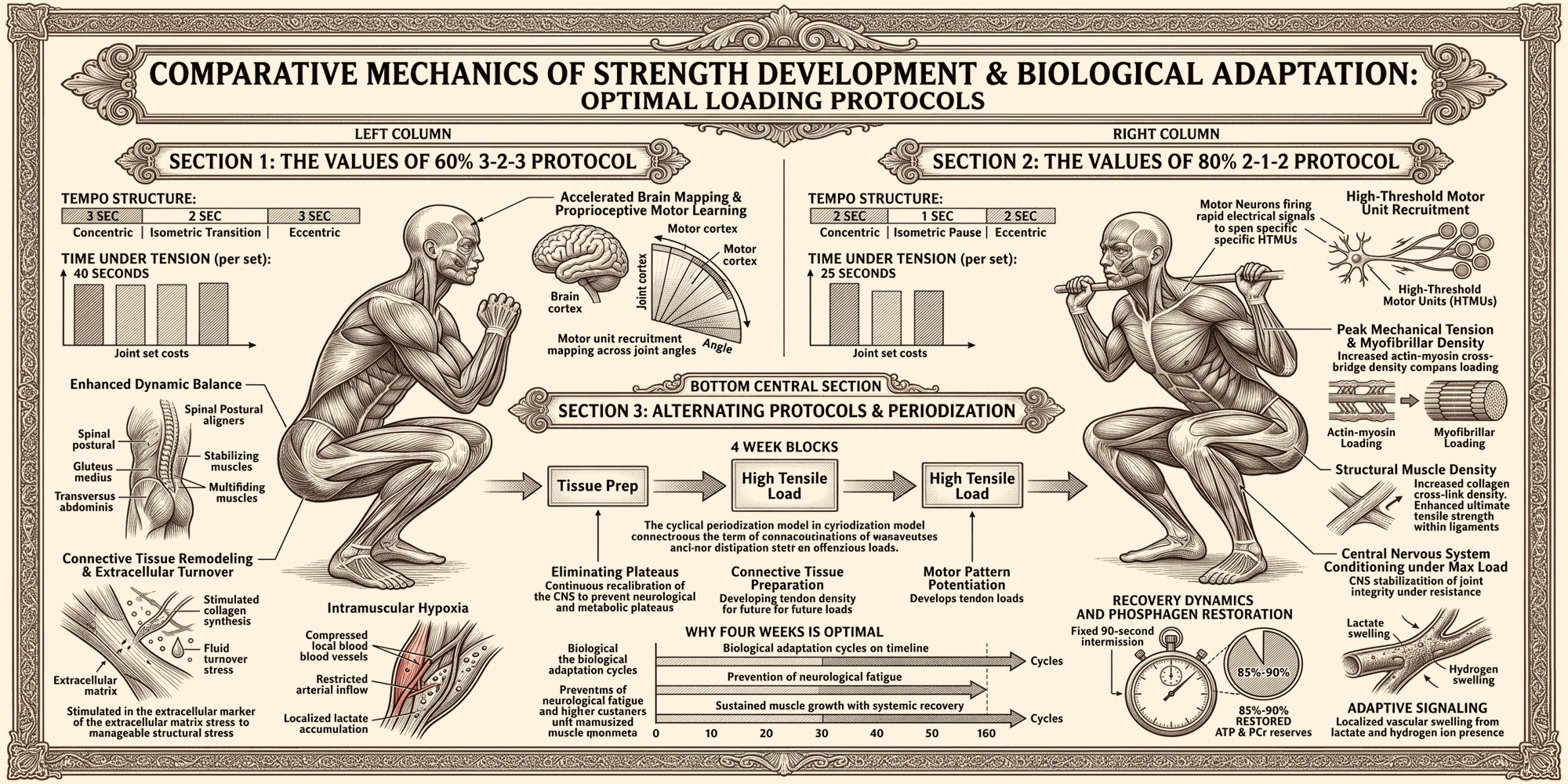
To achieve peak strength, an intensity level of 85% or higher is required to maximize neuromuscular adaptation. However, year-round exposure to this level of stress can lead to exhaustion of the central nervous system and structural overload. Athletes build a solid physiological foundation by maintaining working loads within the 60–80% intensity range. This structural foundation provides the necessary biological framework for transitioning into performance cycles reaching 90% intensity and above.
Mechanics of Intensity, Tempo, and Rest Intervals
Resistance Intensity Parameters
Training intensity defines the magnitude of external load lifted relative to maximum capacity, expressed as a percentage of an individual’s one-repetition maximum (1RM). This parameter dictates the specific physiological adaptations within muscle tissue and the central nervous system. Loading at 60% of 1RM provides moderate resistance that maintains continuous movement control and prolonged time under tension. Loading at 80% of 1RM subjects the neuromuscular system to high mechanical loads, forcing maximal force production.
Tempo Structure and Continuous Isometric Integration
Tempo numbers define the duration in seconds for each phase of a movement repetition. The first digit represents the concentric phase, the second digit represents the isometric hold at the transition point, and the third digit represents the eccentric phase.
A 3-2-3 tempo maintains unbroken mechanical tension across the full joint trajectory. Moving with precise control through three-second concentric and eccentric phases enforces continuous muscle activation and eliminates momentum. The two-second isometric hold isolates the transition point, maximizing force generation at challenging biomechanical angles. Performing a set of 5 repetitions at a 3-2-3 tempo produces 40 seconds of continuous intramuscular tension.
A 2-1-2 tempo requires 2 seconds of concentric lifting, a 1-second isometric pause, and 2 seconds of eccentric lowering. Performing a set of 5 repetitions at a 2-1-2 tempo produces 25 seconds of continuous tension under high mechanical loading.
A 2-0-2 tempo eliminates the transition pause, requiring 2 seconds of concentric lifting and 2 seconds of eccentric lowering. Performing a set of 3 repetitions at a 2-0-2 tempo produces 12 seconds of continuous mechanical strain under near-maximal loading.
Recovery Dynamics and Phosphagen Restoration
A fixed 90-second intermission between sets facilitates substantial resynthesis of intramuscular adenosine triphosphate and phosphocreatine reserves while preserving a controlled metabolic stimulus. Restricting recovery to 90 seconds maintains controlled metabolic fatigue across sequential sets. Persistent intracellular lactate and hydrogen ion accumulation induces localized cell swelling, a mechanism hypothesized to contribute to anabolic signaling pathways within working muscle tissue. As primary high-threshold motor units fatigue during later sets, the central nervous system engages surrounding motor unit pools to sustain force delivery throughout the full range of motion.
Determining Baseline 1RM Parameters
Recalibrating baseline intensity before every training cycle maintains optimal mechanical tension across all working sets. This systematic recalculation aligns future loading parameters with newly acquired structural and neural adaptations, driving continuous strength progression.
Submaximal evaluation is safe and provides precise data for designing an optimal program. In contrast, direct 1RM testing involves heavy mechanical and neurological stress, which is unnecessary for most athletes. Conducting three to four technical repetitions at 90–93% intensity provides an accurate estimate of updated 1RM performance metrics.
Conducting the submaximal assessment after at least one full rest day ensures complete systemic recovery and an accurate maximal result. Conducting three to four technical repetitions with a load equivalent to 90–93% of the projected 1RM yields the exact figures required for mathematical estimation formulas.
Mathematical Formula for 1RM Calculation
Calculating the updated maximum relies on standardized relative strength formulas like the Brzycki formula which maintains high accuracy between 1 and 10 repetitions.
1RM = Weight Lifted / (1.0278 - (0.0278 * Repetitions))Section 1: The Values of 60% 3-2-3
Accelerated Brain Mapping and Proprioceptive Motor Learning
Executing 8-second repetitions at 60% intensity provides the central nervous system with prolonged afferent sensory feedback. Extended movement duration gives the motor cortex the time and sensory information required to map motor unit recruitment across the full range of joint movement. Sustained signaling reinforces cortical representation, accelerating motor unit recruitment and improving rate coding. Slower movement speeds eliminate momentum, ensuring active muscle tissue generates continuous force throughout every degree of joint articulation. This environment establishes 60% 3-2-3 as the superior protocol for beginners acquiring new techniques, granting the brain optimal time to establish accurate motor patterns.
Enhanced Dynamic Balance and Postural Stability
Sustained two-second isometric holds at transition points target stabilizing muscle groups and spinal postural aligners. Pausing at the weakest biomechanical angles eliminates momentum, forcing local stabilizers to generate continuous isometric force. Strengthening these stabilizing networks increases time-to-fatigue during single-leg or complex multi-joint movements. Continuous sensory feedback from muscle spindles and Golgi tendon organs sharpens proprioceptive acuity. This prolonged activation builds robust joint position sense, enabling athletes to maintain dynamic equilibrium and precise structural control across extended athletic performances.
Connective Tissue Remodeling and Extracellular Turnover
Generating 40 seconds of continuous tension per set applies steady mechanical strain across connective tissues throughout the repetition. Extended time under tension stimulates collagen synthesis and accelerates fluid turnover within the extracellular matrix. Prolonged isometric holds strengthen the tendon-to-bone junction while keeping peak mechanical stress within a manageable structural threshold.
Intramuscular Hypoxia, Soreness, and Energy Turnover Adaptation
Prolonged muscle contraction compresses local blood vessels, restricting arterial inflow and creating intramuscular hypoxia. Maintaining 40 seconds of unbroken tension increases local reliance on anaerobic glycolysis and induces structural muscle fiber strain, contributing to post-exercise soreness across the training session. Repeated exposure to this metabolic stress across successive training sessions compels cellular machinery to upgrade its capacity, driving structural adaptations that expand microvascular networks, enhance mitochondrial efficiency, and increase the overall rate of energy turnover.
Section 2: The Values of 80% 2-1-2
High-Threshold Motor Unit Recruitment
Loading at 80% of 1RM with a 2-1-2 tempo demands high voluntary effort, driving rapid recruitment of high-threshold motor units from the initiation of movement. In accordance with Henneman’s size principle, high force demands rapidly progress recruitment up through fast-twitch Type II muscle fibers within the first fraction of a second of the lift. Training at 80% intensity conditions the central nervous system to maximize rate coding and motor unit synchronization. This heightened signaling elevates neural drive, optimizes force transmission across active cross-bridges, and maximizes absolute force production throughout the set.
Peak Mechanical Tension and Myofibrillar Density
Loading at 80% of 1RM generates high peak mechanical tension per repetition, driving maximum strength adaptations and myofibrillar muscle density. Sustaining high mechanical load across a 25-second set maximizes cross-bridge cycling between actin and myosin filaments, transducing tensile forces through mechanotransduction pathways that include integrin-mediated signaling. This intracellular signaling triggers targeted myofibrillar protein synthesis, increasing functional cross-sectional area and contractile density. Concurrently, high mechanical stress stimulates extracellular matrix fibroblast activity, accelerating collagen cross-link density and enhancing the ultimate tensile strength of connective tissue. This structural adaptation increases overall ligamentous stiffness, reinforces joint load tolerance, and protects passive structures during maximal force expression.
Central Nervous System Conditioning Under Max Load
Executing 5-repetition sets at 80% intensity trains the nervous system to control heavy external resistance under significant mechanical demand. Sustained exposure to heavy loads increases efferent neural drive, reinforcing motor cortex signaling efficiency and spinal reflex pathways. Repeated exposure to heavy loading trains the central nervous system to reduce antagonist co-contraction, directing maximum efferent neural drive to the primary working agonists. Retaining precise stabilizing activation protects joint structures under near-maximal loads, ensuring efficient force transmission and maximal net joint torque output.
Section 3: The Benefits of Alternating Between 60% 3-2-3 and 80% 2-1-2 Protocols
Synergistic Neuromuscular Adaptations
Alternating four-week mesocycles between 60% 3-2-3 and 80% 2-1-2 creates the primary training engine for structural hypertrophy, motor control, and sustainable strength. The 60% block establishes precise motor unit coordination, enhances local microvascularization, and conditions periarticular connective tissues through sustained time under tension. Transitioning directly into four weeks at 80% intensity leverages these refined neural pathways and reinforced structural foundations to express maximum force under heavier mechanical loads.
Foundational Macrocycle Base
Continuous rotation between 60% and 80% protocols forms a self-sustaining training system for long-term physical development. Executing multiple consecutive 60% and 80% mesocycles builds structural resilience, myofibrillar density, and high movement quality while keeping central nervous system strain within sustainable recovery boundaries. This foundational alternating sequence fulfills the complete strength and conditioning needs of most athletes. Specialized realization protocols at 90% intensity serve as an optional peak phase, introduced selectively after establishing an extensive multi-mesocycle foundation.
Connective Tissue Preparation and Load Tolerance
Transitioning from the 60% protocol to the 80% protocol systematically elevates peak tensile strain across articular structures. The lower-intensity mesocycle establishes mechanical strain tolerance under continuous time under tension, preparing connective networks for the higher peak forces of the 80% protocol. This progressive increase in mechanical stress reinforces passive collagen architecture, protecting periarticular structures against overload during heavy loading.
Motor Pattern Potentiation and Skill Transfer
Transitioning back to the 60% protocol following four weeks at 80% intensity fundamentally alters central nervous system load perception. Heavy loading leaves behind two distinct neurological and mechanical adaptations: reduced antagonist co-contraction paired with improved motor unit synchronization, and an elevated maximum strength baseline. Consequently, moderate loads represent a smaller percentage of absolute capacity, causing weights to feel significantly lighter upon return. This shift in relative load perception allows athletes to execute the 3-2-3 tempo profile with elevated movement precision, refined motor control, and uninterrupted mechanical tension across every repetition.
Why Four Weeks Is the Optimal Period
Block Periodization Boundaries
Block periodization theory establishes a targeted training mesocycle as a concentrated block lasting two to four weeks, during which specific motor abilities receive primary training emphasis. Four weeks represents the upper boundary of this validated mesocycle window. This timeframe provides sufficient volume-intensity exposure to drive neural adaptations within a specific intensity zone and tempo profile before competing adaptations interfere with targeted motor qualities.
The Neural-to-Hypertrophy Transition
Neuromuscular drivers of strength evolution shift predictably across a four-week mesocycle. Foundational research by Moritani and deVries (1979) establishes that strength increases during initial training exposure stem predominantly from neural adaptations, including heightened motor unit recruitment, increased firing rates, and improved synchronization. Hypertrophic adaptation progressively assumes a primary role across the third to fifth week window. A four-week mesocycle captures the primary arc of neural adaptation, establishing an optimal point to recalibrate intensity and shift the training stimulus.
Differentiated Tissue Adaptation Timescales
Biological structures adapt along distinct operational timelines under mechanical strain. Skeletal muscle tissue demonstrates rapid morphological responses, displaying measurable increases in muscle cross-sectional area within three to four weeks of high-intensity loading. Connective structures, including tendons and periarticular aponeuroses, adapt along a slower timeline. Measurable increases in tendon stiffness and cross-sectional area typically emerge after eight to twelve weeks of continuous loading, with structural adaptations compounding progressively across successive training cycles. A four-week mesocycle aligns with the neural and muscular adaptation curve, while connective tissue properties develop continuously over extended periods.
Prevention of Physiological Accommodation
Sustaining a fixed loading stimulus beyond four weeks triggers biological accommodation, diminishing the magnitude of neuromuscular adaptation. Systematically rotating between 60%, 80%, and 90% protocols at four-week intervals maintains continuous central nervous system responsiveness. This planned rotation disrupts routine adaptation patterns, recruits varied motor unit pools, and optimizes long-term force expression across training macrocycles.
Why Four Sets Is the Optimal Battery
Defining a set battery establishes the precise intra-session volume required for a given movement pattern. A battery of four consecutive working sets delivers the exact stimulus required to maximize high-threshold motor unit recruitment while keeping central nervous system fatigue and metabolic depletion within sustainable recovery limits.
Metabolic Limits of the 60% 3-2-3 Protocol
At 60% intensity executed with a 3-2-3 tempo profile, energy substrate depletion represents the primary physiological bottleneck. Four working sets generate 160 seconds of continuous intramuscular tension, driving anaerobic glycolysis and localized metabolic stress to its optimal threshold. Executing a fifth set accumulates 200 seconds of total mechanical strain, exhausting local glycogen reserves and inducing excessive metabolic fatigue. This extreme substrate depletion delays cellular recovery, extends post-exercise restoration timelines, and compromises subsequent training frequency.
Neural Recovery and Intra-Session Variety at 80% 2-1-2
At 80% intensity with a 2-1-2 tempo profile, capping volume at a maximum of four working sets preserves central nervous system integrity and bioenergetic capacity. Restricting mechanical strain to 100 seconds per movement enables the nervous and energy systems to recover rapidly between bouts. This accelerated recovery timeline permits high training frequency, supporting four to five structured training sessions per week. Additionally, capping working volume at four sets leaves adequate systemic capacity within a single workout, enabling the inclusion of multiple distinct movement patterns and skill practice without exceeding neuromuscular recovery limits.
Central Nervous System Constraints and Pure Realization at 90% 2-0-2
At 90% intensity executed with a 2-0-2 tempo profile, central nervous system strain constitutes the ultimate physiological ceiling. Near-maximal loading requires peak motor unit discharge rates and maximum voluntary efferent drive. Four working sets yield 12 repetitions and 48 seconds of maximal mechanical strain, saturating high-threshold motor unit recruitment. Exceeding four sets causes rapid neuromuscular exhaustion, diminishing rate coding and compromising structural stability. Pure strength realization depends strictly on maximal neural stimulation; working sets below 90% intensity are omitted during this realization battery to concentrate total bioenergetic output on peak force expression.
Section 4: The Values of 90% 2-0-2 for Pure Strength Realization
Progression to Maximal Strength Realization
Developing peak strength requires incorporating a four-week block of 90% intensity with a 2-0-2 tempo directly after completing a four-week block at 80% 2-1-2. This targeted sequence converts the structural resilience, myofibrillar density, and load tolerance established during the 80% phase into maximal neural output, completing the macrocycle progression from structural preparation to peak force expression.
Parameters of the Maximal Load Protocol
The 90% intensity protocol reduces set volume to 3 repetitions while retaining the fixed 90-second rest intermission between sets. Each repetition follows a 2-0-2 tempo profile, creating 12 seconds of total continuous mechanical strain under near-maximal resistance. Retaining the 90-second recovery window maintains partial phosphagen restoration, sustaining neuromuscular readiness for maximal force output across sequential sets.
Maximal Rate Coding and Peak Neural Drive
Loading at 90% of 1RM forces the central nervous system to recruit maximal high-threshold motor unit pools from the initiation of movement. Executing 3 repetitions at near-maximal intensity demands peak motor unit firing rates. Restricting total set duration to 12 seconds focuses metabolic output on peak force expression, maximizing neurological adaptations and rate coding.
Mechanics of the 2-0-2 Tempo Profile
Removing the isometric hold at the transition point requires an immediate reversal of force direction under near-maximal resistance. The 2-second concentric phase demands maximal voluntary acceleration intent against heavy loading, while the 2-second eccentric phase maintains strict active control against gravity. Eliminating the transition pause trains continuous motor unit synchronization during fluid reversal of joint articulation under severe mechanical stress.
References
- Gabriel, D. A., Kamen, G., & Frost, G. (2006). Neural adaptations to resistive exercise. Sports Medicine, 36(2), 133–149.
- Supports the role of resistive exercise in driving neural adaptations, including increases in motor unit recruitment, firing rates, and central motor cortical efficiency during dynamic movements.
- Burd, N. A., Andrews, R. J., West, D. W. D., Little, J. P., Cochran, A. J. R., Hector, A. J., Cashaback, J. G. A., Gibala, M. J., Potvin, J. R., Baker, S. K., & Phillips, S. M. (2012). Muscle time under tension during resistance exercise stimulates differential muscle protein sub-fractional synthetic responses in men. The Journal of Physiology, 590(2), 351–362.
- Supports time under tension as an independent training variable, demonstrating that extended time under tension at light load (30% 1RM) increases mitochondrial and sarcoplasmic protein synthesis acutely and produces a delayed rise in myofibrillar protein synthesis 24–30 hours post-exercise.
- Mersmann, F., Bohm, S., & Arampatzis, A. (2017). Imbalances in the development of muscle and tendon as risk factor for tendinopathies in youth athletes: A review of current evidence and concepts of prevention. Frontiers in Physiology, 8, 987.
- Supports the necessity of periodizing mechanical load to balance rapid neuromuscular adaptation with the slower remodeling rates of tendon structures.
- Baz-Valle, E., Balsalobre-Fernández, C., Alix-Fages, C., & Santos-Concejero, J. (2022). A systematic review of the effects of different resistance training volumes on muscle hypertrophy. Journal of Human Kinetics, 81, 199–210.
- Supports the relationship between resistance training volume and muscle hypertrophy outcomes, establishing how manipulating training variables influences hypertrophic signaling.
- Lazarczuk, S. L., Maniar, N., Opar, D. A., Duhig, S. J., Shield, A., Barrett, R. S., & Bourne, M. N. (2022). Mechanical, material and morphological adaptations of healthy lower limb tendons to mechanical loading: A systematic review and meta-analysis. Sports Medicine, 52(10), 2405–2429.
- Supports the biological rationale for progressive load increases by demonstrating that mechanical loading induces positive adaptations in tendon stiffness, tensile modulus, and structural material properties.
- Bernárdez-Vázquez, R., Raya-González, J., Castillo, D., & Beato, M. (2022). Resistance training variables for optimization of muscle hypertrophy: An umbrella review. Frontiers in Sports and Active Living, 4, 949021.
- Supports the primary interactions between mechanical tension, metabolic stress, and movement speed in driving skeletal muscle structural remodeling.
- Baar, K. (2017). Minimizing injury and maximizing return to play: Lessons from engineered ligaments. Sports Medicine, 47(Suppl 1), 5–11.
- Supports the physiological mechanism where sustained isometric contractions and controlled strain stimulate collagen synthesis and extracellular matrix fluid exchange.
- Villanueva, M. G., Villanueva, M. G., Lane, C. J., & Schroeder, E. T. (2012). Influence of rest interval length on acute testosterone and cortisol responses to volume-load–equated total body hypertrophic and strength protocols. Journal of Strength and Conditioning Research, 26(10), 2755–2764.
- Supports selecting 90-second rest intermissions by demonstrating acute testosterone and cortisol responses relative to shorter rest intervals across volume-load-equated protocols.
- McCaulley, M. D., McBride, J. M., Cormie, P., Hudson, M. B., Nuzzo, J. L., Quindry, J. C., & Travis, T. N. (2009). Acute metabolic and neuromuscular responses to hypertrophic, strength, and power resistance training protocols. Journal of Strength and Conditioning Research, 23(2), 548–555.
- Supports a strict four-set battery ceiling by demonstrating that exceeding per-session volume thresholds during high-intensity protocols produces acute decrements in rate of force development and elevates markers of central neuromuscular fatigue.
- Schoenfeld, B. J., Grgic, J., & Krieger, J. W. (2019). How many times per week should a muscle be trained to maximize muscle hypertrophy? A systematic review and meta-analysis of studies examining the effects of resistance training frequency. Journal of Sports Sciences, 37(11), 1286–1295.
- Supports dispersing total volume across higher weekly frequencies (4–5 sessions per week) to manage per-session volume, preserve neuromuscular execution quality, and accelerate systemic recovery.
- Aagaard, P., Simonsen, E. B., Andersen, J. L., Magnusson, P., & Dyhre-Poulsen, P. (2002). Increased rate of force development and neural drive of human skeletal muscle following resistance training. Journal of Applied Physiology, 93(4), 1318–1326.
- Supports high-intensity loading for driving maximal motor unit discharge rates, efferent neural drive, and rapid rate of force development.
- Suchomel, T. J., Nimphius, S., Bellon, C. R., & Stone, M. H. (2018). The importance of muscular strength: Training considerations. Sports Medicine, 48(4), 765–785.
- Supports the physiological framework for developing foundational strength prior to transitioning into high-load force realization cycles.
- Wilk, M., Zajac, A., & Tufano, J. J. (2021). The influence of movement tempo during resistance training on physiological responses. Sports Medicine, 51(8), 1629–1645.
- Supports movement tempo control as a primary training variable that directly modulates time under tension, peak force output, and neuromuscular activation.
- Issurin, V. B. (2008). Block periodization versus traditional training theory. Journal of Sports Medicine and Physical Fitness, 48(1), 65–75.
- Supports two- to four-week block periodization mesocycles for concentrating targeted motor abilities before physiological accommodation occurs.
- Moritani, T., & deVries, H. A. (1979). Neural factors versus hypertrophy in the time course of muscle strength gain. American Journal of Physical Medicine, 58(3), 115–130.
- Supports the timeline of initial strength increases stemming primarily from neural adaptations—including motor unit recruitment, synchronization, and firing rates—before structural hypertrophy progressively assumes a primary role between the third and fifth weeks.