Adaptation: The Gift and the Danger
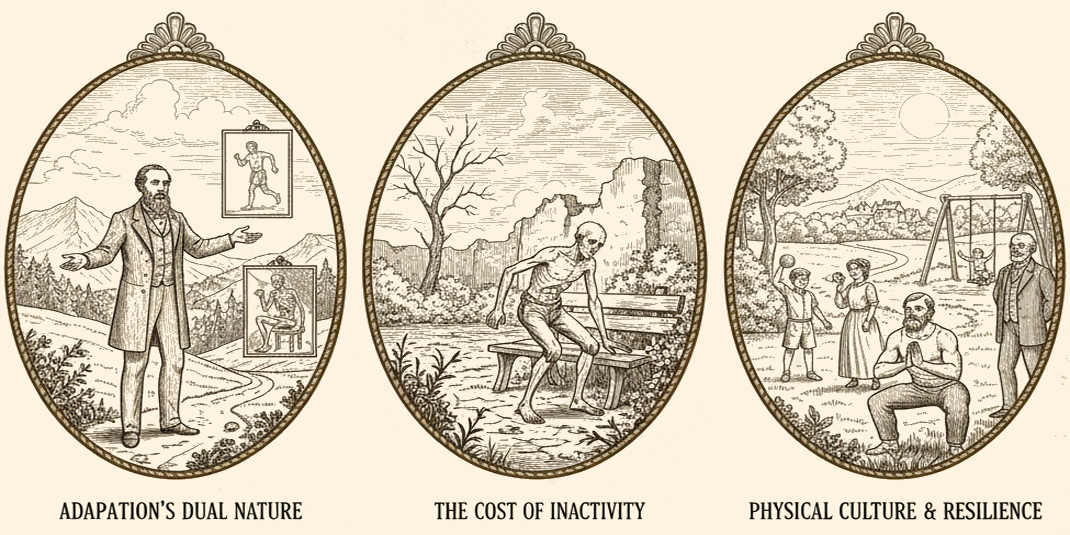
Every animal has a primary defense mechanism and is adapted to its climate and food source. A turtle’s hard shell, for instance, is an innate protection that inevitably comes with a mobility limitation. Its survival depends on this one fixed defense mechanism. In contrast, humans inhabit the entire planet despite its varied climates and food environments. We live everywhere, from the cold of the Arctic to the heat of the desert, and from mountain peaks to ocean shores. Our survival has never depended on armor or claws, but rather on our ability to adapt to our circumstances. This ability is called adaptation, and it is both physical and mental.
Adaptation is the only physical gift that nature gave humans. It enables muscles to grow stronger under strain, lungs to expand with training, and the nervous system to master complex movements. However, adaptation is neutral; it conforms to whatever we repeatedly do. If you train with purpose, you will grow stronger, more vital, and more resilient. But if you sit idle in front of a screen, your body will adapt toward weakness and decay.
The Cost of Inactivity
When muscles go unused, the body begins to dismantle them in order to conserve energy. The tissue that once provided strength and support weakens. Over time, the nervous system loses the ability to fully activate it. Joints stiffen, their range of motion decreases, and the muscles that control them lose strength and precision. Prolonged sitting further reduces the body’s need for mobility, replacing freedom of movement with restriction. The natural fluidity of walking, running, bending, or reaching is replaced by stiffness, imbalance, and instability.
Even more harmful are long periods of lying down or complete inactivity. In such conditions, internal organs begin to atrophy due to lack of demand, and the circulation of blood and nutrients weakens. This leaves tissues starved and vulnerable to decay. Sporadic attempts at physical activity then lead to rapid fatigue because the body lacks the reserve capacity to respond. Deprived of regular practice, the brain loses the habit of coordinating safe and efficient movement. This breakdown of motor control increases the likelihood of muscle and tendon strains and tears, clearly showing that inactivity destroys the body rather than preserving it.
The Role of Physical Culture
Physical culture is the discipline that directs adaptation wisely. It is the art and science of harnessing the body’s natural tendency to change in a way that strengthens rather than weakens us. By teaching the body to move correctly, physical culture protects the joints and preserves proper posture. Developing and maintaining strength keeps the muscles alive and capable of supporting daily life functions. By preserving mobility, physical culture safeguards freedom of motion and prevents the slow decline into stiffness and limitation that inactivity brings. In this way, physical culture becomes a compass that steers the natural law of adaptation toward health and longevity.
The practice of physical culture is deliberate and sustained. It requires regularity, patience, and an understanding that true improvement takes time. Through steady practice, the body remains balanced, circulation stays strong, and the nervous system sharpens its ability to coordinate safe, efficient movement. This continual renewal prevents decline and builds a lasting foundation of resilience. Balance, vitality, and readiness become the natural state of being, and adaptation itself becomes an ally — a force that supports human growth at every stage, from youth to old age.
General Physical Preparation: The Right Push
A sound system of general physical preparation provides the body with the necessary push to adapt properly. Rather than leaving change to chance, it provides structured, purposeful training that strengthens every part of the human body. It keeps the organs active and efficient, sustains the circulation of blood and nutrients, and preserves the joints through their full range of motion. At the same time, strength and endurance develop in harmony, ensuring that all body parts function equally for the benefit of the entire body. By integrating these elements, general physical preparation establishes a solid foundation on which all other activities can safely build.
Equally important is its influence on the nervous system. General physical preparation trains the body to coordinate precise movements, stabilize under pressure, and act efficiently rather than wastefully. This balance of physical and neural training protects individuals from the destructive effects of passivity, such as weakened muscles and lost mobility. By consistently challenging the body in measured ways, GPP turns the principle of adaptation into a lifelong ally. It also equips a person with lasting resilience and vitality, as well as the capacity to meet life’s demands.
Final Thoughts
Adaptation is our only weapon and it must be honed through discipline. Left unguided, it turns against us, reshaping the body toward weakness and decline. When guided by physical culture and strengthened by general physical preparation, adaptation becomes a lifelong ally, preserving mobility, protecting health, and sustaining vitality. Through deliberate practice, we ensure that the principle upon which human survival depends fosters growth, resilience, and balance throughout life.