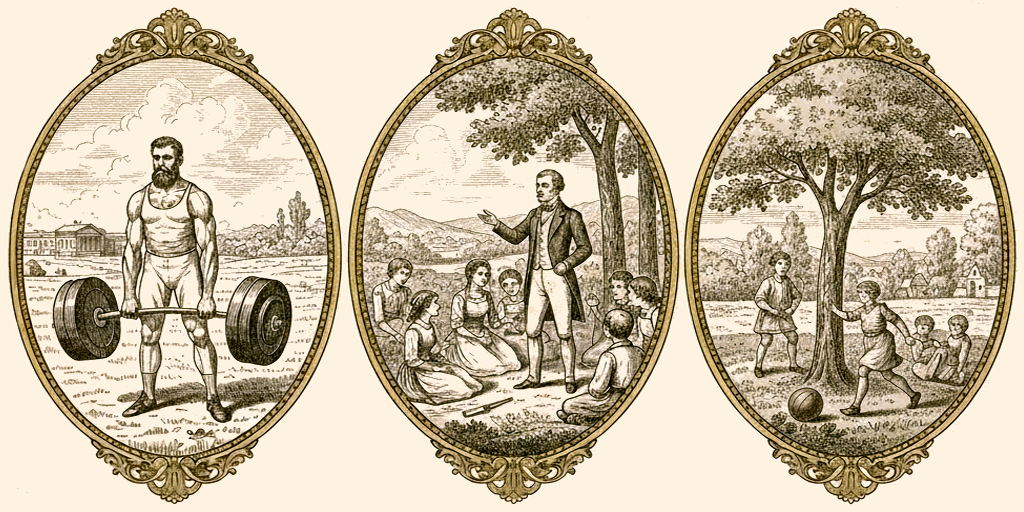
The body is a classroom that never closes. Practice movement precisely, patiently, and repeatedly. This shapes muscles and joints and teaches the brain a way of organizing action, attention, and effort. This disciplined education of the body builds automatic motor patterns, sharpens executive skills, and fosters steady patience and social habits. These elements form a solid foundation for more complex projects. Physical culture is a mode of lifelong learning. This practical pedagogy trains the whole person to meet struggle with composure and to act in the world with measured power and clear judgment.
Movement Becomes Knowledge
Learning a movement follows certain stages: an early cognitive phase of conscious effort, an associative phase of refinement, and an autonomous phase when the movement is executed smoothly with little conscious thought. This progression—from effortful doing to reliable automaticity—frees cognitive resources and builds confidence. The brain’s ability to automate reliable motor programs is a remarkable feat. It makes complex actions repeatable, efficient, and available under pressure. Respecting these stages transforms capability into habit.
Physical activity influences the brain at multiple levels, improving attention, working memory, and other executive functions that underpin disciplined thinking and decision-making. Regular physical activity is essential for maintaining neural health and cognitive performance throughout your life. It makes the brain more responsive, more plastic, and better at sustaining focus when it matters. Disciplined physical training is an investment in mental clarity and practical problem-solving.
Physical Effort Teaches Beyond Sports
Mastering the body teaches adeptness in managing social, business, or scientific networks. Sport and structured physical practice foster life skills—such as teamwork, self-regulation, goal setting, and perseverance—that are useful beyond sport. It is essential to deliberately take pedagogical steps to connect physical practice to life outside the gym.
Play and sport are essential training in movement, sociality, and character for children. Free play and organized activities build motor competence, social understanding, emotional regulation, and healthy bodies. Playing fully, correctly, and consistently teaches children essential life skills such as awareness, attention, endurance, cooperation, and controlled risk. Coaches, parents, and teachers must protect and structure opportunities for rich movement experiences while preserving the joy and spontaneity that make play such a powerful teacher.
Practical Principles for Teaching the Body-University
Teach through stages by respecting the cognitive → associative → autonomous progression of motor learning and designing practice that deliberately guides learners through those phases. Prioritize quality and consistency. Habitual, correct practice builds dependable movement patterns. Connect physical skills to real life by making transfer explicit. Reflect with learners, name the life skill—patience, planning, teamwork—and create opportunities to practice that skill outside the gym. This process effectively transforms body-forged habits into valuable social and professional resources. Protect play for children by ensuring daily, varied movement experiences that combine guided skill work with free play.
Physical culture is an education of attention, courage, and a taste for measured effort. It teaches how to begin, how to continue, and how to finish well. It forms a temperament—steady under pressure, precise in motion, generous in collaboration—that translates into clearer thought, stronger will, and steadier relationships. With wise teaching and patient practice, the body becomes what every great university strives to be: a laboratory where character is forged, skills are refined, and the whole person is prepared to act with dignity and purpose.
Final Thoughts
Physical culture is a lifelong curriculum. Practice it correctly and consistently, and you will develop habits of attention, patience, and moral poise. These habits carry into every domain of life. Teach with care, protect play, and insist on quality over quantity so that the movements learned become reliable tools under pressure. It is essential to explicitly link effort to teamwork, planning, and resilience. Reflect to ensure that body-forged skills translate into wise action. This keeps the body a living laboratory—where character is formed, judgment is refined, and the whole person is prepared to meet the world with dignity and purpose.